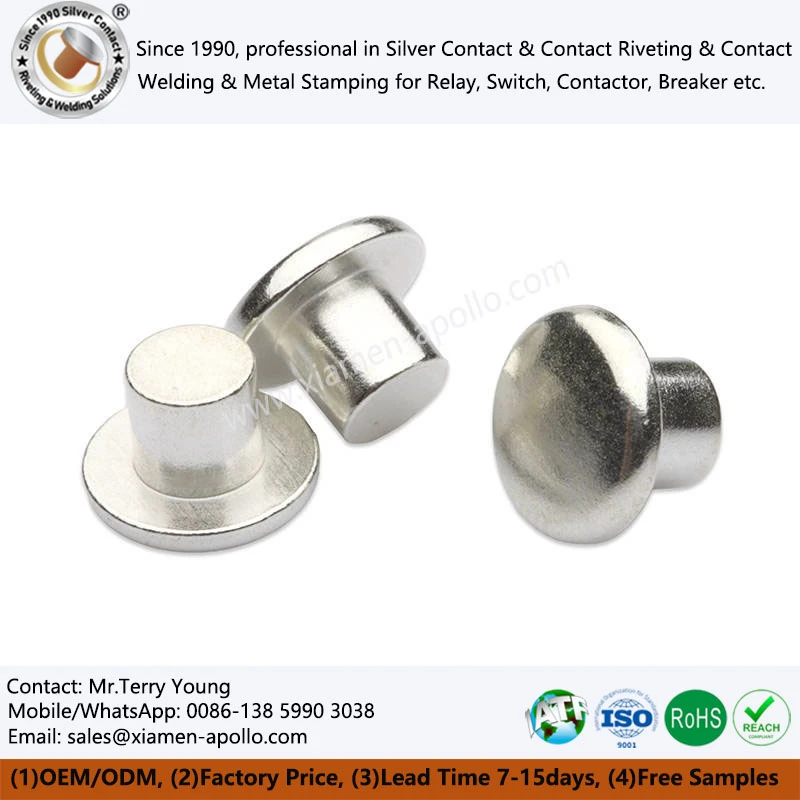
A Monometal Contact Rivet is a solid switching element cold-headed from one alloy wire, the same metallurgy running from the contact face through the shank. Fine silver, AgNi10 and silver-tin oxide are the three grades that carry most of the volume. The part contains no cladding line, no weld seam and no dissimilar metal interface inside its body. That single material condition fixes the electrical and thermal behavior of the rivet before it ever reaches a test bench, and it is the reason monometal construction remains the reference design for contactors, miniature circuit breakers and high-voltage DC relays.
The material case starts with conductivity. Silver sits at the top of the metal table at 1.59 μΩ·cm resistivity, or 63.0 MS/m, against 1.68 μΩ·cm for copper. Nothing else in commercial use comes close on a cost-adjusted basis for a switching surface. A Solid Electrical Contacts therefore carries current through the same alloy at the tip, the shoulder and the shank, which keeps current density uniform through the cross-section and removes the local hot spot that forms at a bonded joint.
What Separates a Solid Ag Contact from a Composite One
Composite rivets bond a silver-bearing tip to a copper or brass shank. The bond is made by resistance welding, friction welding or clad strip stamping, and each of those processes introduces an interface that has to be controlled, inspected and, in the field, trusted. Monometal parts skip that step entirely. The wire is drawn to final diameter, cut to slug length, and upset in a die to form the head.
Three consequences follow for a design engineer. First, there is no bond line to fail under thermal cycling. Silver and copper expand at different rates, so a bimetallic joint accumulates shear stress every time the contactor switches and cools. A single-alloy rivet expands and contracts as one body. Second, there is no interface resistance added to the contact resistance budget, which matters when the rivet sits in a 500 A DC path and every micro-ohm costs watts. Third, scrap recovery is clean. A Silver Electrical Contacts returns a single-alloy stream to the refiner, while a composite part forces the refiner to separate silver from the copper shank before assay.
The trade-off is silver mass. A solid rivet uses expensive metal where a composite uses brass. The decision is a cost model, not an opinion, and it is covered below.
Alloy Selection: Fine Silver, AgNi10 and Silver-Tin Oxide
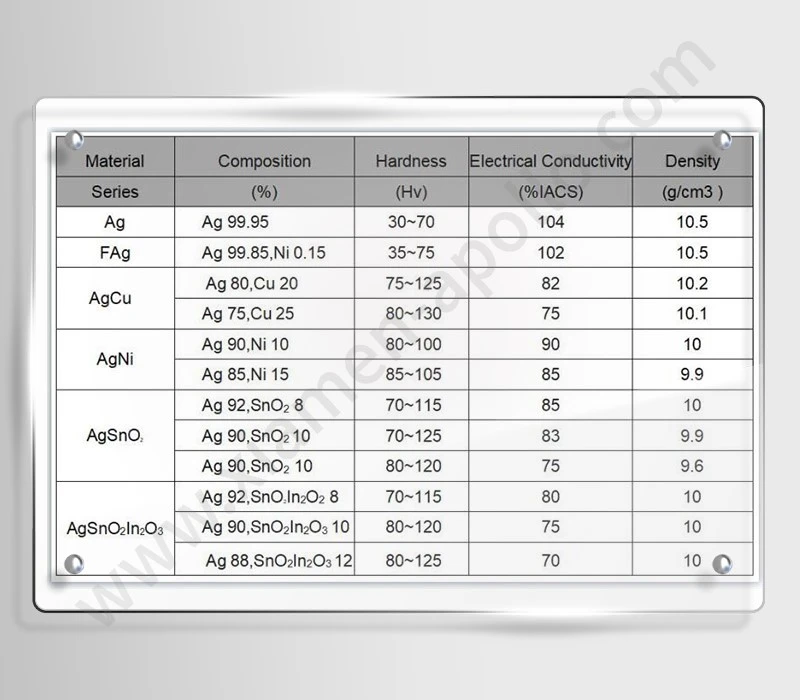
Fine silver, at 99.95% minimum assay, gives the lowest contact resistance of any practical grade. It also work-hardens readily and cold heads well. Its weakness is mechanical and metallurgical. Under an arc, fine silver welds and erodes, and it tarnishes in sulfur-bearing atmospheres because silver sulfide films grow on the surface and raise contact resistance over time. Fine silver suits low-arc-energy signal and control relays, not motor switching.
AgNi10 is nominally 90 wt% silver with 10 wt% nickel. The nickel disperses as a fine second phase and interrupts weld bridges between the closing surfaces. Hardness and wear resistance rise, arc welding drops, and conductivity stays high enough for general-purpose loads. This grade is the workhorse for contactors and motor protection devices that see frequent operations.
Silver-tin oxide grades, typically with a tin oxide fraction around 8 to 12 wt%, are the answer to DC arc erosion. Tin oxide particles raise the viscosity of the molten pool and suppress material loss per break, which extends electrical life in high-current DC switching. Modern variants add indium or bismuth oxides to stabilise the microstructure and reduce the oxide agglomeration that older tin oxide grades showed after long arcing.
Cadmium oxide grades are effectively closed to new designs in markets covered by RoHS Directive 2011/65/EU, which restricts cadmium to 0.01% by weight in homogeneous materials. Any Solid Rivet Contacts specified today should be cadmium-free by default.
The Cold Heading Chain Behind the Rivet
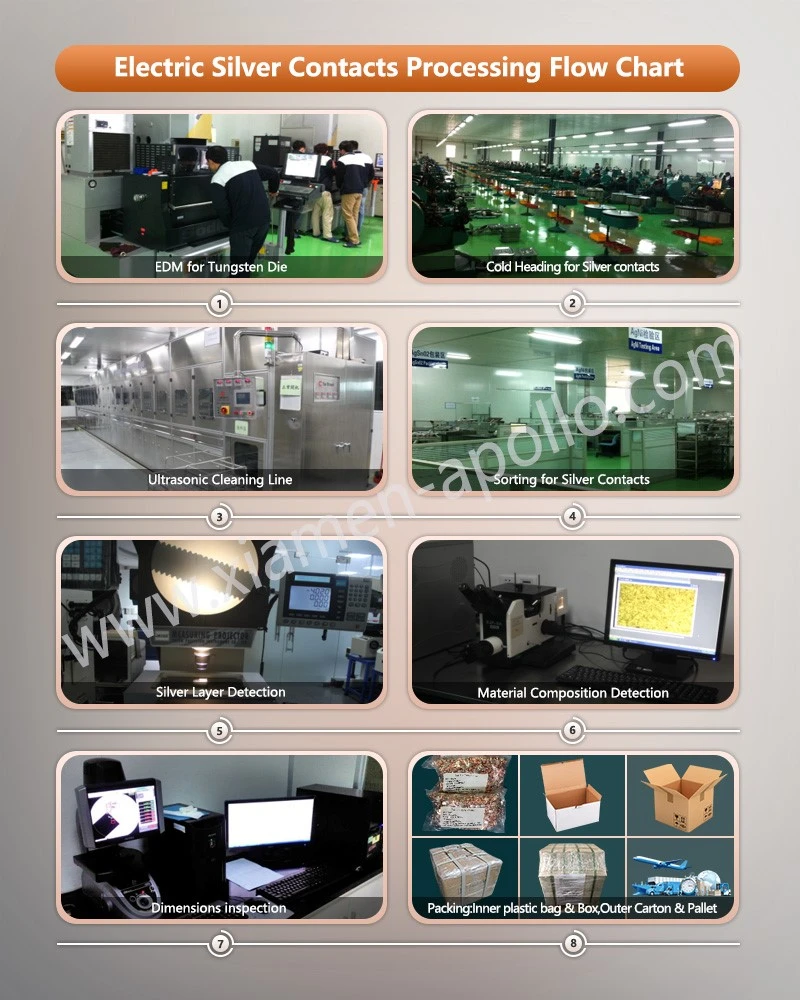
Wire drawing sets the starting condition. Silver and silver alloys are drawn through carbide dies with intermediate anneals, because the alloys work-harden quickly and a single-pass reduction would shear the surface. Diameter tolerance, surface finish and the absence of die lines are all set at this stage, and none of them can be corrected later at the header.
Heading is the forming step that gives the rivet its geometry. A slug is cut to a weighed length, then upset in a die under a controlled stroke. The heading ratio, the die radius and the lubrication layer determine whether the head fills cleanly or folds. A folded head shows as a lap line under magnification, and it is a reject, because the lap becomes a crack origin under thermal and mechanical load.
Annealing follows heading when the alloy requires it. AgNi10 headed at high reduction needs a soft, ductile state for the shank so the rivet can be set without splitting. Atmosphere control matters here, since silver picks up sulfur and oxygen at temperature.
Finishing covers deflash, tumbling for edge radius, and optional plating. Silver plating on a silver rivet is not decorative; it is a solderability and storage measure for the assembly line. Tin and nickel finishes serve specific termination methods. A Silver Contact Points that will be staked into a copper terminal usually ships with a controlled shank hardness rather than a coating.
Arc Behavior, Contact Resistance and the Numbers That Matter
Silver melts at 961.8 °C and boils at 2212 °C. Those two values frame the whole erosion problem, because the arc root reaches temperatures far above the boiling point and vaporises metal from a small area on every break. The alloy's job is to spread that energy over a wider area, raise the pool viscosity and shorten the arc duration.
Welding is the second failure mode. Two silver surfaces that close on a molten bridge can join, and the joint may hold when the contactor tries to open. Nickel in AgNi10 and oxide particles in silver-tin oxide both reduce the molten bridge cross-section. Monometal construction supports this because the alloy is uniform through the head; a composite part with a thin silver tip can erode through the tip and expose the bond zone, at which point welding behavior changes abruptly.
Contact resistance is the third. Fresh silver surfaces sit in the low micro-ohm range. Tarnish films, and especially silver sulfide, add resistance and are the practical limit in humid, sulfur-bearing plant environments. Storage and packaging specifications belong in the purchase drawing for that reason, not in a general note.
Where Demand Is Moving
Low-voltage AC contactors remain the largest outlet for these parts, and that base is stable. Growth is concentrated in DC. Battery electric vehicles, charging equipment, storage cabinets and photovoltaic combiners all switch DC, and DC arcs do not self-extinguish at current zero the way AC arcs do. Designers respond with series-connected break gaps, magnetic arc blow and higher-erosion alloys, and each of those raises the specification on the rivet rather than lowering it.
High-voltage DC contactors in vehicles add two requirements that favour solid construction: current paths sized for continuous rated current rather than short-time overload, and a service life counted in make-break operations against a fixed vehicle life. A Pure Silver Contact in the main path removes one interfacial variable from a system that already has enough of them.
Incoming Inspection for QA Teams
A workable receiving plan for Solid Silver Contact Rivet is short. Verify alloy grade by assay or by certificate with the silver fraction stated. Check head diameter, head thickness, shank diameter and overall length against the drawing with a defined sampling plan. Check shank hardness, because soft shank is a staking failure and hard shank is a cracking failure. Check surface for laps, folds and die marks at magnification. Check plating thickness by X-ray fluorescence when plating is specified. Confirm that the parts are cadmium-free and that the certificate matches the delivered lot.
None of these checks requires a sectioning lab, which is the practical advantage of a solid part. A composite rivet adds a bond integrity check, usually by ultrasonic or by destructive shear, and that check is a recurring cost on every lot.

The Cost Question Procurement Should Actually Run
The comparison is not silver price against brass price. It is total metal cost per accepted switching operation. A composite part buys less silver, and it also buys a bond process, a bond inspection step, a scrap separation cost at end of life and a failure mode that shows up as field returns rather than as in-house rejects. A monometal part buys more silver in a single alloy that the refiner takes back at a known assay.
Run the model on your own duty cycle. Where operations per life are high and the current is heavy, the erosion and welding margin of a Solid Contacts Rivet usually closes the metal cost gap. Where the load is light and the shank is long, composite or a trimmed monometal geometry may win. The number that settles it is cost per million operations at your rated current, not cost per piece at the bench.
contact us
Send us your Monometal Contact Rivet drawing with the alloy grade, the head geometry and the annual volume. We draw, head, anneal, finish and inspect monometal and composite parts on the same line, so the comparison can be quoted on identical tooling assumptions rather than on two suppliers' different ones. Include the switching duty and the required electrical life in the enquiry, and we will return a process route with the alloy recommendation that supports it.