In AC circuits, the current passes through zero twice per cycle; the arc naturally extinguishes at the zero-crossing point, making arc suppression relatively straightforward. In contrast, high-voltage DC relays-which utilize Copper Sheet Stamping for EV Relay-carry a constant current direction with no natural zero-crossing point. Once an arc forms, it persists between the contacts; external structures are required to cool, elongate, and split the arc to achieve extinction. This absence of a zero-crossing point represents a core technical challenge distinguishing high-voltage DC relays from conventional AC relays, imposing rigorous demands on the design, materials, and manufacturing precision of the internal copper stamped parts.
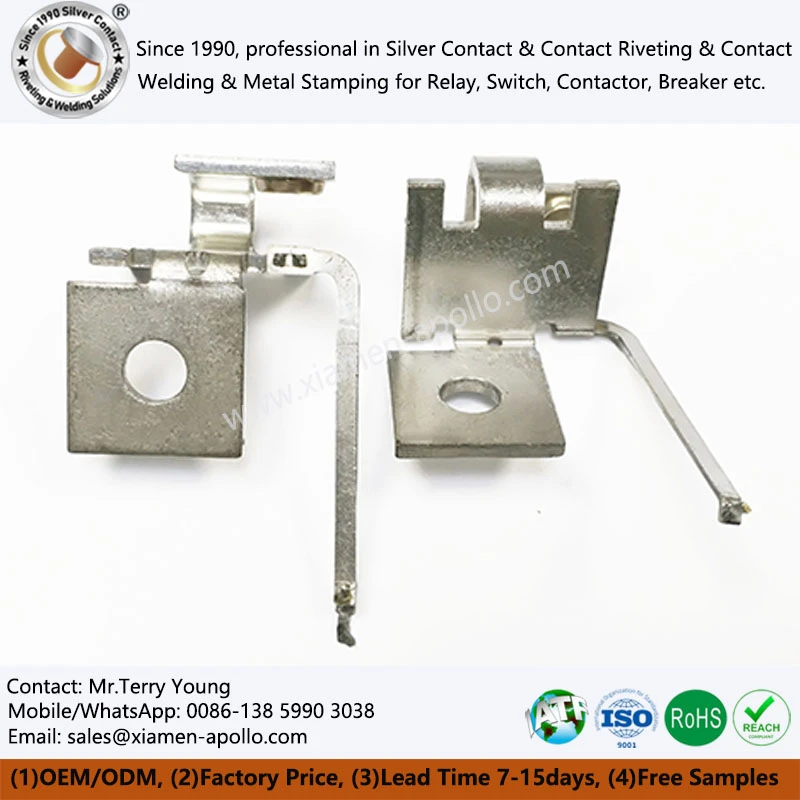
A sustained DC arc can reach temperatures of several thousand degrees Celsius, continuously eroding contact surfaces and causing contact material to melt, evaporate, and spatter. Contact degradation leads to increased contact gaps and rising contact resistance, which in turn intensifies heat generation during closure, creating a vicious cycle. If arc energy is not rapidly dissipated, the insulation integrity of the sealed chamber can be compromised; at DC bus voltages ranging from several hundred to over a thousand volts, this creates a high risk of short circuits and fires caused by arcing. Internal Copper Contact Terminal for EV HVDC Relay Contactor serve as both conductive elements and elastic supports, enduring prolonged exposure to temperature rises, thermal radiation from the arc, and cyclic mechanical shock; any failure to meet dimensional tolerance or surface quality standards further exacerbates contact conditions.
To address the challenge of DC arc extinction, high-voltage DC relays employ various suppression strategies: sealed ceramic chambers filled with inert gas or hydrogen (leveraging hydrogen's high thermal conductivity to accelerate arc cooling); built-in magnetic blowout structures that use the Lorentz force to drag, elongate, and split the arc, thereby increasing arc column resistance to achieve extinction; and vacuum interrupters in some designs, which rely on the high dielectric strength of a vacuum to rapidly extinguish the arc. The stable operation of the entire arc-extinguishing assembly relies on precision Copper Stamping Terminal for EV Charging Relay that serve as conductive paths, spring supports, and terminal connection carriers; factors such as flatness, burr control, and spring-back management of these copper components directly impact internal assembly precision and electrical conductivity stability.
Contact material selection must also be suited to DC breaking conditions. Composite contact materials-such as silver-tin oxide and silver-zinc oxide-form an oxide-particle framework at high arc temperatures; this structure inhibits the flow of the silver matrix, thereby reducing the risk of contact welding. High-voltage DC relays require larger contact gaps than AC relays of the same current rating to extend the arc cooling path, while simultaneously necessitating sufficient contact pressure to maintain low, stable contact resistance. This pressure is provided by the associated Custom Copper Stamping for EV Relay; the base material and stamping process determine the long-term stability of the spring force, preventing contact degradation caused by fatigue failure.
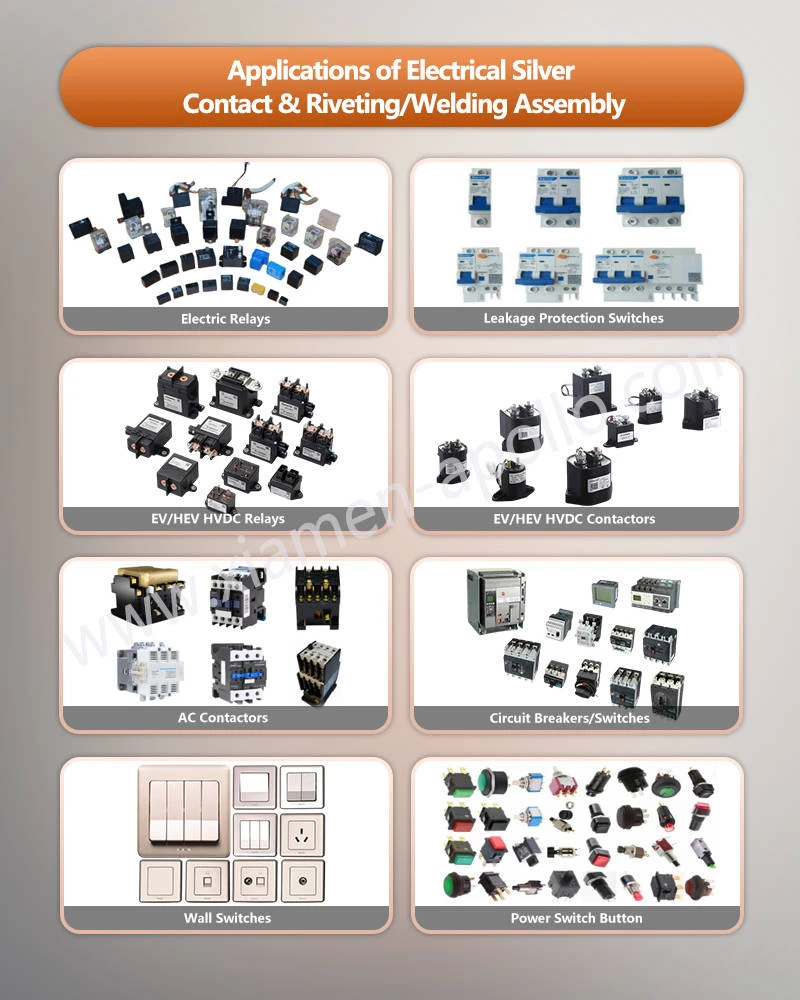
When selecting high-voltage DC relays, system engineers must evaluate not only rated voltage and current parameters but also breaking capacity curves, maximum breaking current, and load time constants. In DC circuits with higher inductance, greater magnetic field energy is stored at the moment of breaking, making arc extinction more difficult. If the circuit time constant exceeds the product's tested limits, derating or the selection of a device with higher breaking specifications becomes necessary.
The operation of high-voltage DC relays under DC load conditions is essentially a challenge of managing arc energy on a millisecond timescale. It requires the safe dissipation of arc energy to protect contacts and the sealed housing, while also demanding that internal Fixed Copper Terminals for New Energy High Voltage Relay-such as those used in EV relays-possess precise dimensions, stable mechanical properties, and excellent conductivity to ensure long-term reliability within the vehicle's high-voltage system. This represents both a core challenge in high-voltage relay design and a key technical focus for the development of copper stamped components.
contact us
Submit your Copper Sheet Stamping for EV Relay drawings and performance requirements immediately to leverage our factory's precision progressive stamping capability for high-volume automotive-grade components.