

Fastener Industry Overview
Definition
Fasteners are a general term for a type of mechanical parts used to fasten two or more parts (or components) together to form a whole. They are the most widely used mechanical basic parts, widely used in automobiles, energy, electronics, electrical appliances, machinery, and other industries. Various fasteners can be seen in various mechanical equipment, vehicles, ships, railways, bridges, buildings, instrument meters, etc.

According to the product form classification, fasteners usually include the following 12 categories: bolts, studs, screws, nuts, self-tapping screws, wood screws, washers, retaining rings, pins, rivets, welding nails, assemblies, and connection pairs. This is also the traditional classification method for fasteners in my country, and this classification method has been used in my country's national standards. Among them, according to whether the geometric structure contains threaded features, fasteners are divided into threaded fasteners (such as bolts, nuts, etc.) and non-threaded fasteners (such as washers, retaining rings, pins, ordinary rivets, ring groove rivets, etc.).
Industry chain analysis: downstream application areas are extensive
The upstream of the fastener industry mainly includes raw materials and fastener production equipment, among which raw materials include steel, non-ferrous metals such as copper and aluminum, and plastics; fastener production equipment includes cold heading machines, hot forging machines, etc.
The midstream of the fastener industry is the production link of fasteners, which can be divided into metal fastener production and plastic fastener production according to the fastener materials.
The downstream application range is wide, including automobiles, machinery, home appliances, construction, rail transportation, shipbuilding, etc.
Industry development history: global voice continues to increase
Upstream supply: China ranks first in the world in steel production, and the production of copper, aluminum, and other metals continues to rise
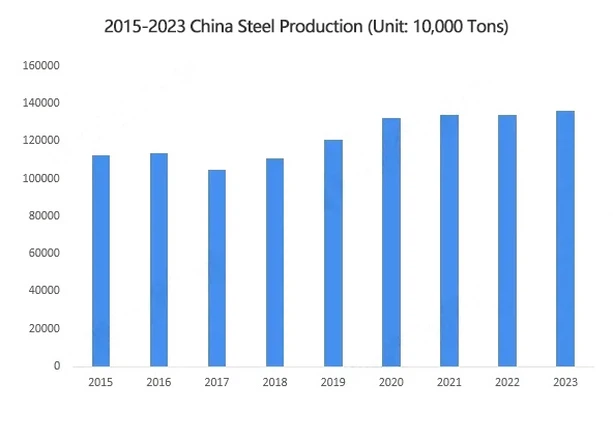
The main raw material of fastener products is steel. According to the data from the National Bureau of Statistics, my country's steel production showed a fluctuating and increasing trend from 2015 to 2021. In 2021, my country's steel production reached 1336.668 million tons, reaching a peak in recent years, an increase of 0.6% year-on-year, and the growth rate has dropped significantly. In 2022, the output reached 1.34 billion tons, and in 2023, the steel production reached 1362.68 million tons, an increase of 5.2% year-on-year.
In addition to steel, copper, and aluminum are also important raw materials for fastener products. Compared with steel fasteners, copper fasteners have the advantage of better conductivity, while aluminum fasteners are lighter and have a higher strength-to-weight ratio.
Since 2016, my country's refined copper and primary aluminum production has generally shown an upward trend. In 2022, refined copper production reached 11.1153 million tons, up 5.99% year-on-year, while primary aluminum production reached 40.1443 million tons, up 4.26% year-on-year. In 2023, China's refined copper and primary aluminum production will reach 12.99 million tons and 41.59 million tons, respectively.
Industry development pain points: weak core technology and unreasonable product structure
The core technology of my country's fastener industry is relatively weak, mainly manifested in insufficient core technology innovation capabilities, few original technology products, long R&D cycles, and low efficiency. The fastener manufacturing industry started late in my country. Although domestic enterprises have made significant achievements in digesting and absorbing foreign advanced technologies, overall, there is still a big gap between the independent innovation and technology R&D capabilities of domestic enterprises and foreign enterprises. In addition, the manufacturing technology of high-end fasteners itself involves a wide range of areas, high complexity, and lack of professional R&D and innovation personnel, which makes my country's talents, technologies, and equipment in the six major professional fields of materials science, pressure science, technicians, surface treatment, heat treatment, and experimental science required for the production of high-end fasteners have a certain gap with foreign countries.
In addition, the structural irrationality formed by long-term low-level duplicate construction has led to a structural surplus in my country's fastener production. On the one hand, the market for ordinary fasteners is saturated, products are overstocked, and production capacity is oversupplied, resulting in low-level duplicate construction and homogeneous vicious competition. On the other hand, high-strength fasteners used in industries such as automobiles, infrastructure, aerospace, and engineering machinery are in short supply. Most domestic companies have weak R&D capabilities and low levels of process equipment. Only a few domestic companies are engaged in high-end market business and have to rely heavily on imports for a long time.
Industry development prospects
The direction of product structure adjustment in China's fastener industry is becoming increasingly clear. High-end fastener products in the industry will develop rapidly, and product-added value will increase rapidly. At the same time, the development of overseas markets such as countries along the Belt and Road will further promote the development of export trade in my country's fastener industry. It is expected that the market size of my country's fastener industry will continue to grow in the next five years. By 2028, the market size of China's fastener industry will exceed 180 billion yuan.