Latching relays are bistable relays that utilize short-duration current pulses to toggle contact states, maintaining their operational status even after power is cut off. Because the coil consumes energy only during the tens of milliseconds required for contact switching-resulting in near-zero standby power consumption-performance relies heavily on a critical internal magnetic component: the Latching Relay Magnet Insert Molded Sub‑Assembly. This sub-assembly is formed through an integrated insert molding process combining a DT4E electrical pure iron armature, a ferrite magnet, and engineering plastic; it is the key component determining the magnetic circuit performance, holding force, and operational stability of the relay. Driven by the demand for new energy solutions and smart technologies, the industry is continuously evolving, creating growth opportunities for upstream permanent magnet and soft magnetic materials.

Market Size and Growth Drivers of Bistable Relay Magnet Plastic Insert Component
The market for latching relays continues to grow steadily, with demand for Plastic Encapsulated Magnet for Bistable Relay expanding across three major downstream application sectors:
- New Energy Vehicles (NEVs): As vehicle high-voltage architectures upgrade from 400V to 800V, demand for high-power, high-voltage-rated latching relays is rising rapidly. Components such as traction batteries, A/C compressors, and PTC heating units utilize multiple high-voltage latching relays, driving the need for associated Insert Molded Permanent Magnet Relay Parts that offer higher temperature resistance and superior magnetic stability.
- Smart Grids and New Energy Storage: Latching relays are widely used in IR46 smart meters, photovoltaic inverters, energy storage BMS systems, and charging piles. Thanks to their zero-power holding capability and long-term reliability, the DT4E armature and ferrite insert-molded magnet assembly has become the core of the magnetic circuit in this equipment.
- Industrial Automation and Smart Homes: PLCs, industrial robots, and remotely controllable appliances (such as smart water heaters and air conditioners) extensively employ latching relays, driving mass production demand for small-to-medium-sized Custom Insert Molding Magnet Relay Components.
Market data indicates that the market size for high-voltage latching relays was approximately $862 million in 2024, with a compound annual growth rate (CAGR) of about 4.0%, and is projected to reach $1.133 billion by 2031. The broader magnetic relay market stood at approximately $5.22 billion in 2025 and is expected to grow to $8.11 billion by 2032 at a CAGR of 6.50%; continued expansion in downstream sectors is driving shipment volumes for injection-molded magnetic components.

Technical Development Trends of Insert Molded Magnet Relay
Upgraded downstream operating conditions are driving continuous optimization of Magnetic Latching Relay Spare Parts Moving Magnet in terms of materials, structure, and manufacturing processes:
- Adaptation to High Voltage and High Current: To meet the demands of high-power applications in new energy vehicles and energy storage systems, the voltage withstand rating of latching relays has been raised to 1.5 kV or higher. Consequently, the corresponding injection-molded magnetic components require optimized magnetic permeability for DT4E armature plates, adjustments to ferrite magnet dimensions, and refined injection-molding encapsulation structures to ensure stable magnetic circuit holding force under high-current surges.
- Enhanced Adaptability to Diverse Operating Environments: Adjustments to engineering plastic substrates and injection-molding processes enable integrated magnetic components to operate within a temperature range of -40°C to 85°C (or even wider). These improvements enhance vibration and moisture resistance, thereby extending the relay's service life under harsh conditions. Machining precision and surface treatment processes for DT4E electrical pure iron armatures are simultaneously optimized to minimize magnetic reluctance fluctuations.
- Miniaturization and Integration: On one hand, magnetic circuit structures are optimized to achieve sufficient holding force within limited space, reducing the overall volume of the injection-molded component. On the other hand, in-mold injection processes are improved to reduce assembly steps and enhance product consistency. Coupled with built-in relay diagnostic functions, requirements for controlling the dispersion of magnetic performance in these components have become increasingly stringent.
Industry Competitive Landscape of Latching Relay Magnet Assembly
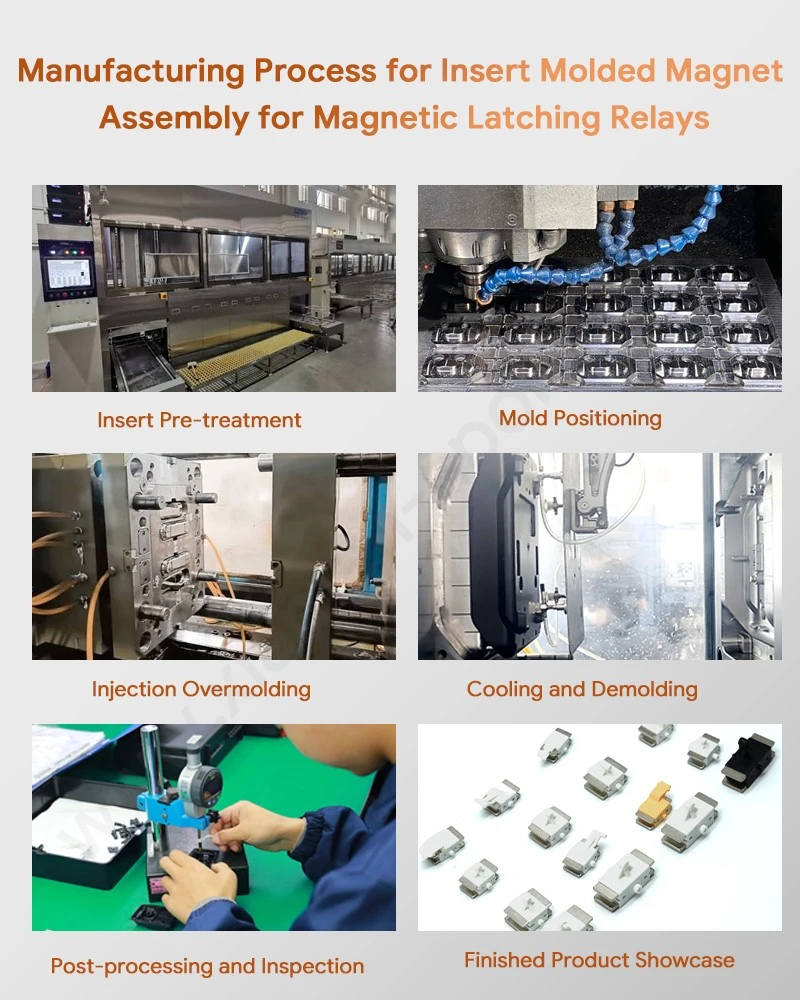
The global latching relay market is characterized by a landscape where the market is concentrated among leading players, while small and medium-sized manufacturers remain fragmented. China is the world's largest market for the production and consumption of relays; in 2024, domestic relay sales reached approximately RMB 36.5 billion, underpinned by a significant advantage in having a complete industry chain. Domestic relay manufacturers excel in large-scale production and cost control, continuously penetrating the high-end market while driving the development of upstream supporting industries for magnetic steel injection-molded components. As customized precision structural parts, these components require advanced capabilities in DT4E armature stamping, magnetic chip positioning, in-mold injection molding, and magnetic performance testing, representing a segment with high technical barriers within the relay supply chain.
Impact on the Upstream Materials Industry for Magnetic Steel Injection-Molded Components
The growing demand for magnetic latching relays directly drives the need for raw materials such as DT4E electric pure iron, ferrite permanent magnets, and engineering plastics:
Higher Material Performance Requirements: Magnetic steel injection-molded components must simultaneously meet requirements for high armature magnetic permeability and stable ferrite coercivity, while ensuring that engineering plastics do not crack or delaminate during long-term thermal cycling. The dual demands for relay miniaturization and stable holding force compel upstream suppliers of soft magnetic and permanent magnetic materials to continuously optimize batch consistency.
Highlighted Value of the Local Supply Chain: The scale advantage of China's relay industry has fostered the maturity of supporting sectors such as DT4E armature stamping, ferrite magnetic chip production, and in-mold injection molding. A local supply chain enables rapid response to customization needs for various magnetic latching relay models, optimizes costs and delivery times for injection-molded magnetic components, and supports domestic relay products in competing within the global market.
contact us
We possess mature, end-to-end manufacturing capabilities-encompassing DT4E armature processing, magnet matching, and precision in-mold injection molding-that enable us to rapidly fulfill custom mass-production orders for Latching Relay Magnet Insert Molded Sub‑Assembly. We invite global B2B clients to collaborate with us on prototyping and secure a competitive edge in the market.