

In recent years, with the rapid development of the global automotive, power electronics, and high-end manufacturing industries, the demand for high-reliability electrical contact materials has continued to rise. Among them, Tungsten Contacts, with their excellent arc resistance, low vapor pressure, high melting point, and good thermal stability, have become core components in many critical electrical systems. However, in actual production, Tungsten Contact Rivets materials often face technical challenges such as wall cracking, brittle fracture, coarse or unevenly distributed grains in the fracture surface, and deviations in rod diameter control, which seriously affect product yield and service performance. To address these issues, some domestic manufacturers have significantly improved product quality stability through systematic process optimization.
However, in the actual production process of Tungsten Steel Contact materials, due to the complex material structure and high processing difficulty, problems such as wall cracking, brittle fracture, uneven grain distribution on the cross-section, and difficulty in controlling rod dimensions often occur. These defects not only affect the mechanical properties of the product but also directly reduce the conductivity stability and service life of the contacts in actual operation. Therefore, systematically analyzing the key factors affecting quality and optimizing the production process is of great significance for improving the yield and reliability of Tungsten Point Contact materials.
From the perspective of material performance, Car Horn Tungsten Contact Rivets materials possess a series of excellent properties. First, tungsten has an extremely high melting point, enabling it to maintain a stable structure under high-temperature arc conditions. Second, the material has a low coefficient of thermal expansion, making it less prone to structural deformation during frequent switching on and off of power. Furthermore, tungsten has a low vapor pressure and a slow volatilization rate at high temperatures, thus exhibiting good resistance to ablation under arc conditions.

Despite the excellent properties of tungsten materials, their production still faces numerous technical challenges. One of the most common problems is the metallurgical defects within the billet. During tungsten smelting, insufficient raw material purity or improper process control can easily lead to the formation of pores, inclusions, or impurities within the billet. These defects weaken the bonding strength between metal grains, causing cracks or even fractures during subsequent plastic processing. For example, certain low-melting-point impurities, such as lead and bismuth, often reside at grain boundaries, easily becoming the starting point for crack propagation during processing, leading to splitting or brittle fracture.
Secondly, controlling the initial powder particle size and proportion is crucial in the powder metallurgy stage. Uneven particle size distribution or insufficient mixing can easily lead to the formation of different crystal structures during sintering, such as a mixture of fine, coarse, and frame-like grains. This structural difference affects the overall processing performance of the material, resulting in poor plastic deformation capacity in some areas, leading to localized cracking during rotary forging or stretching. Therefore, strict control of powder particle size distribution and ensuring uniform mixing are crucial during the preparation of Pure Tungsten Discs.
Furthermore, process control during billet pressing and sintering also significantly impacts product quality. Uneven pressing pressure distribution leads to inconsistent internal density in the billet, resulting in an uneven structure. During subsequent sintering, different regions shrink at varying degrees, causing delamination or cracks. Simultaneously, unstable sintering temperature control or insufficient holding time can lead to under- or over-burning, causing abnormal changes in grain structure and affecting subsequent processing performance.
In the processing of Powder Petallurgy Tungsten Discs, rotary forging is a critical step in forming the final product. Rotary forging effectively refines the grain structure and increases material density. In the initial stages of processing, a higher pass rate can be used to increase production efficiency, allowing the billet to quickly approach the target size. However, near the finished product stage, the pass rate must be strictly controlled to prevent excessive deformation that could cause internal cracks. Typically, the pass rate in the one or two processes before the finished product should be controlled between 12% and 15%, while the final product rate should be further reduced to between 5% and 9%.
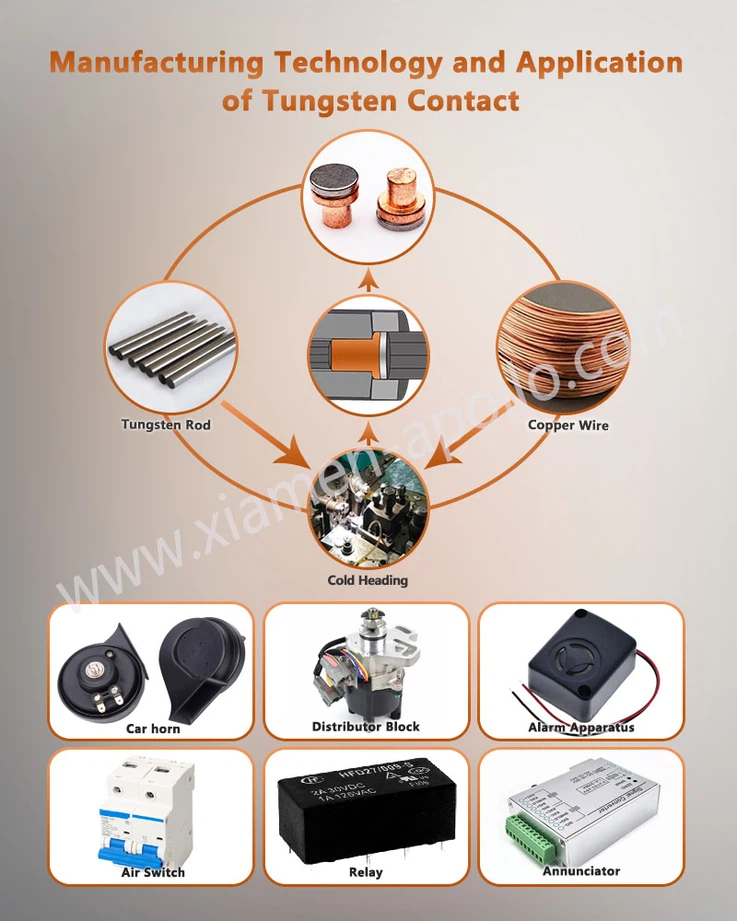
In modern electrical equipment, Tungsten Contact Rivets are not only used in traditional industrial control systems but also widely applied in automotive electronics, communication equipment, and new energy electrical systems. Products such as Horn Contact Wolfram and Motorcycle Horn Tungsten Rivet play a crucial role in the switching function of automotive horns. Furthermore, with the increasing prevalence of high-power electrical equipment, the demand for high-arc-resistance contact materials is constantly growing, giving products like Tungsten Discs a promising market outlook.
Overall, the production of Motorcycle Horn Tungsten Rivet materials is a complex engineering project involving multiple disciplines such as powder metallurgy, plastic processing, and precision manufacturing. Only through strict control of multiple stages, including raw material selection, sintering processes, rotary forging, and mold design, can the product's stable conductivity and reliable mechanical strength be ensured. With continuous advancements in manufacturing technology and the ongoing expansion of application areas, the importance of Copper Tungsten Contact materials in the electrical industry will further increase.

If you need more information about Iron Tungsten Contact Rivets materials, contact rivets, or electrical contact solutions, please contact us for professional technical support and product information. We will provide you with suitable electrical connection solutions.
Contact Us
