

As a fundamental core component of electrical control systems, the relay is hailed as the "industrial vitamin." Leveraging its core functions-namely, using low-voltage signals to control high-voltage circuits, providing circuit isolation, and enabling automatic regulation-relays are widely applied across fields such as new energy vehicles, smart grids, and industrial automation, serving as critical components that underpin industrial upgrading and energy transition. After more than seventy years of development, my country has emerged as the world's largest producer and consumer of relays. The country has established three major industrial clusters-the Yangtze River Delta, the Pearl River Delta, and the Bohai Rim-supported by a comprehensive and well-integrated supply chain. By 2025, China's relay export volume is projected to reach 2.82 billion units, generating a trade surplus of 7.48 billion RMB and further highlighting the nation's growing global competitiveness. As a core component within the electromagnetic system of a relay, the *Pure Iron Relay Core* has become a mainstream material in the industry; thanks to its high magnetic permeability and low residual magnetism, it ensures the stable and reliable electromagnetic performance of the final product.
The industry is currently navigating a critical phase of transformation and upgrading. Driven by the energy revolution and the rise of intelligent manufacturing, a distinct trend toward high-end development has become evident. The rapid emergence of new sectors-such as new energy vehicles and energy storage systems-has propelled relays into an era of 1500V high-voltage applications, imposing rigorous demands regarding voltage withstand capabilities, operational lifespan, and overall reliability. Such high-end upgrading is inextricably linked to the support provided by core materials; the *Soft Magnetic Iron Relay Core* (a soft magnetic alloy relay core) stands out as a key material choice for the R&D of high-end products, offering superior magnetic properties that are ideally suited to the demanding requirements of high-voltage and high-frequency environments.

Intelligentization represents another core direction for the industry's development, as relays transition from traditional passive control components into intelligent terminals. The new generation of products integrates functions such as status monitoring, fault diagnosis, and remote communication, enabling seamless integration with industrial control systems to meet the demands of Industry 4.0 and smart city initiatives. Data indicates that among newly established automation projects within the global process industry, over 68% require relays equipped with intelligent monitoring interfaces; domestically, shipment volumes for smart relays continue to grow at a rate exceeding 20%. This intelligent upgrade simultaneously drives innovation in manufacturing processes; specifically, "Relay Core Cold Heading"-leveraging its advantages in high precision and high efficiency-has emerged as the mainstream processing method for core components within smart relays.
The transition toward green practices serves as a direct response to the "Dual Carbon" strategy, becoming an inevitable choice for the industry's sustainable development. Leading enterprises are reducing energy consumption through process optimization and raw material recycling; consequently, the utilization rate of recycled silver continues to rise, while vacuum arc-extinguishing technology has significantly reduced the energy consumption per unit of product. Concurrently, demand for energy-efficient relays has surged, and new national standards imposing stricter requirements on product energy efficiency are driving the refinement of the industry's green manufacturing ecosystem. This green development encompasses the entire product lifecycle, with the production of "Iron Cores for Relays" gradually adopting low-carbon processes to minimize energy consumption and emissions, thereby aligning with the industry's green transformation objectives.
Deepening domestic substitution has become a central theme in the industry's development, as technological breakthroughs by local enterprises accelerate the dismantling of foreign monopolies. While the global relay market's high-end segments were once dominated by overseas giants, domestic enterprises-exemplified by Hongfa Corporation and Sanyou Relays-are now gradually achieving substitution in high-end sectors such as automotive and industrial control through focused efforts on core technological breakthroughs. Hongfa Corporation commands a global market share exceeding 21%, ranking among the world's leaders in the high-voltage DC relay market; meanwhile, Sanyou Relays has ranked second in domestic relay sales for eight consecutive years and has participated in the formulation of numerous national standards. This drive for domestic substitution also stimulates the localization of materials; the localization rate for "Pure Iron Rods for Relays" continues to rise, thereby reducing the industry's dependence on foreign sources for high-end products.
At the same time, the industry faces significant barriers to entry, characterized by a four-fold structure of hurdles spanning technology, capital, customer relationships, and policy. On the technological front, high-end relays involve multidisciplinary expertise-ranging from electromagnetic design to precision materials-and require extensive, long-term R&D accumulation to master surface treatment processes (such as "Nickel Plating for Relay Cores") and precision manufacturing techniques. On the capital front, the necessity of investing in automated production lines, precision equipment, and continuous R&D creates a substantial financial threshold for market entry. The customer certification cycle spans 1 to 2 years, resulting in extremely high customer stickiness. At the policy level, stringent standards-such as the EU's RoHS directive and various domestic national standards-serve to raise the industry's barriers to entry.
The continuous expansion of application scenarios is injecting new momentum into the industry's growth. The number of relays utilized per new energy vehicle exceeds that of traditional vehicles by several dozen units; meanwhile, demand in the photovoltaic energy storage and EV charging pile sectors has surged, becoming a core engine for industry growth. Traditional sectors such as home appliances and telecommunications maintain stable demand, while demand in specialized fields-including medical equipment and aviation-is gradually beginning to materialize. This diversification of application scenarios drives the customized upgrading of products; specifically, core components such as "Relay Rods" must be adapted to meet the distinct performance requirements of various scenarios, thereby empowering enterprises to build differentiated competitive advantages.
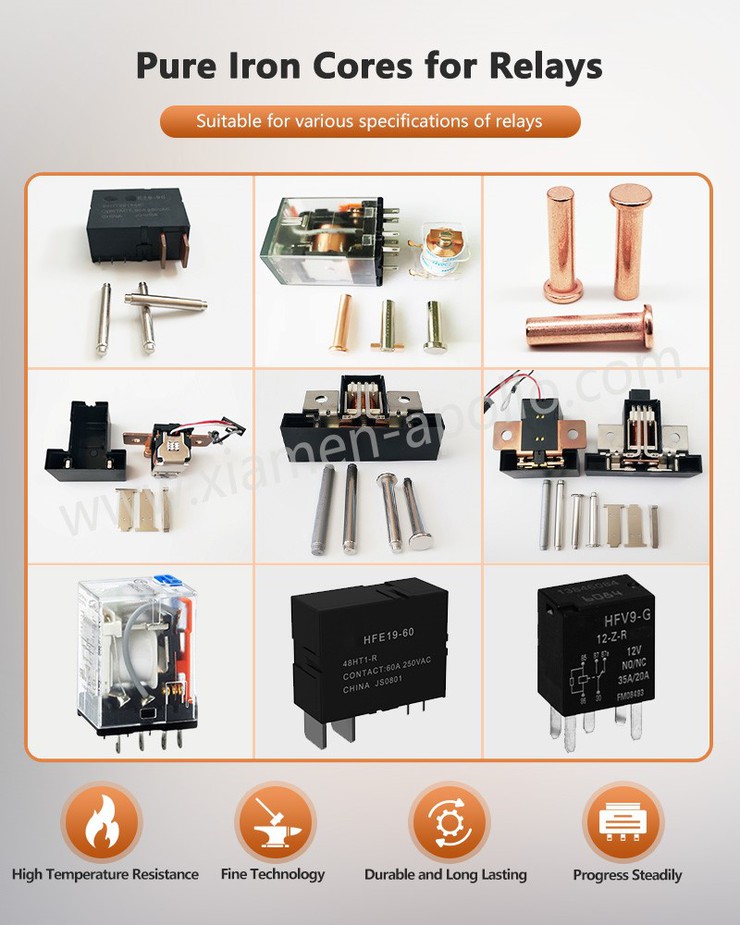
Moving forward, the relay industry will continue its trajectory toward high-end, intelligent, and eco-friendly development, driven by the dual forces of domestic substitution and application scenario expansion. Local enterprises must persist in achieving technological breakthroughs in core components-such as relay core pins-while strengthening supply chain collaboration to enhance their capacity to supply high-end products. Concurrently, they should capitalize on policy opportunities-such as those presented by the RCEP-to expand into emerging markets like Southeast Asia and consolidate their standing in the global market. The industry is poised to pivot from a focus on scale expansion toward high-quality development, thereby becoming a pivotal force in supporting the upgrading of my country's manufacturing sector and the advancement of its new energy industry.
If you require information regarding relay technology selection or application solutions for iron-core relay components, please feel free to contact us for professional technical support.
Contact Us
