

Stainless steel stamping utilizes dies and pressure equipment to apply external force to stainless steel sheets, causing plastic deformation or separation to obtain parts of the desired shape and size. The entire process is typically carried out at room temperature (i.e., cold stamping) and is suitable for stainless steel sheets with thicknesses ranging from 0.02 mm to 2.00 mm. Common raw materials include austenitic series such as 304 and 316 stainless steel, with 304 stainless steel being widely used in stainless steel sheet metal stamping due to its excellent overall properties.
Compared to other metal forming methods, this stamping method can complete multiple processes such as shearing, bending, stretching, and punching in a single or continuous stroke, making it particularly suitable for mass production of small parts with complex structures. For example, stainless steel clips or steel bases for capacitors commonly used in electronic devices often rely on high-precision Galvanized Steel Bracket Stamping processes to achieve their functionality and assembly compatibility.
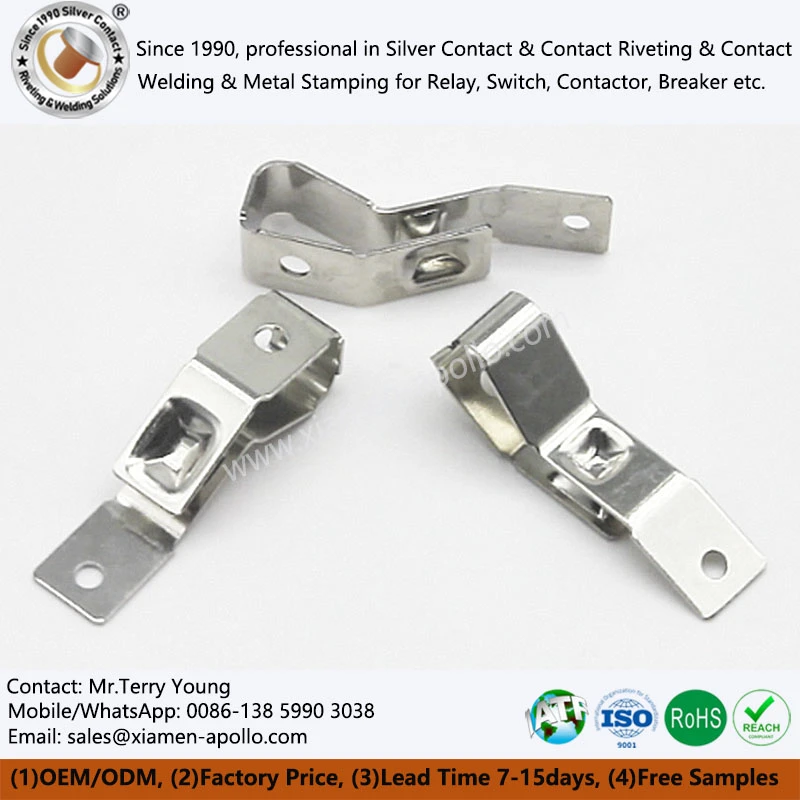
The Core Advantages of Stainless Steel Stamping
First, corrosion resistance and long lifespan are the most significant characteristics of stainless steel. Thanks to the dense oxide film formed by chromium, stamped parts maintain stable performance even in humid, acidic, alkaline, or high-temperature environments, significantly extending product lifespan and reducing maintenance and replacement costs.
Second, high precision and consistency are key reasons why this process is highly favored in modern manufacturing. Advanced mold design and automated stamping equipment ensure that the dimensional tolerances of Stainless Steel Stamped Parts are controlled within ±0.02mm, meeting the extremely high precision requirements of applications such as electronic components and sensor housings.
Third, design freedom and surface aesthetics are equally outstanding. The stamping process can achieve complex contours, internal angles, microholes, and three-dimensional structures while retaining the natural metallic luster of stainless steel. After polishing, brushing, or passivation, the parts not only possess functionality but can also be used directly as aesthetic components, widely applied in high-end home appliances and medical equipment panels.
Furthermore, although stainless steel has lower electrical conductivity than copper or aluminum, its combination of "moderate conductivity + high reliability" remains valuable in applications requiring a balance between conductivity and corrosion resistance-such as battery connectors, grounding terminals, or shielding. This has led to the continued expansion of Electrical Panel Galvanized Steel Stamping applications in the electronic stamping field.
Material Selection and Process Adaptation
In actual production, the process parameters for Galvanized Steel Bracket Stamping need to be adjusted according to the specific grade. Taking 304 stainless steel as an example, its good ductility and work hardening properties are suitable for deep drawing and multi-step forming, but springback control and die wear are process challenges. Therefore, 304 stainless steel punching usually requires the use of high-hardness die steel and a lubrication system to ensure part consistency.
It is worth noting that although this article focuses on stainless steel, in some cost-sensitive or corrosion-independent applications, carbon steel stampings (such as cold-rolled carbon steel stampings) remain the mainstream choice. Cold-rolled carbon steel stampings offer higher strength and lower cost, making them suitable for structural supports or internal brackets. However, stainless steel remains the preferred choice when environmental exposure or long-term reliability becomes a critical consideration.

Typical Applications and Industry Needs
Currently, Steel Electrical Parts are widely used in smartphone SIM card trays, connector terminals, micro-motor housings, and medical surgical instrument components. As electronic products continue to evolve towards thinner, lighter, and more integrated designs, the demand for composite processes such as Stainless Steel Zinc Plating Drawing Stamping Parts, which combine corrosion resistance and conductivity, is also increasing. Furthermore, the trend towards customization has driven the parallel development of customized carbon steel stampings and stainless steel stamping parts, requiring manufacturers to flexibly switch materials and processes to respond to diverse orders.
Galvanized Steel Bracket Stamping, as a crucial step in modern precision manufacturing, integrates multiple technologies including materials science, mold engineering, and automation control. While ensuring high strength, corrosion resistance, and high precision, it also supports complex geometries and the economy of large-scale production. In the future, with the development of new materials and the upgrading of intelligent manufacturing, Electrical Panel Galvanized Steel Stamping will continue to play a core role in high-end manufacturing.
If you would like to learn more about the technical details of Electrical Panel Galvanized Steel Stamping, material selection recommendations, or process feasibility assessments, please contact us-we will provide you with professional technical support and solutions.
Contact Us
