

In the manufacturing of electrical connectors, switches and sockets, relays, terminal blocks, and various precision stamped components, a product's corrosion resistance directly determines its service life and operational reliability. Particularly in humid, high-salinity, or coastal environments, metal materials are more susceptible to corrosive degradation; consequently, manufacturers typically employ salt spray testing to validate their products' resistance to corrosion. For metal stamped parts-such as brass stampings used in switch terminals-salt spray testing has become an indispensable and critical procedure within the product development and quality control processes.
In actual operating environments, the most direct method for verifying a product's corrosion resistance is through long-term natural exposure testing, wherein the product is placed in a real-world setting to observe its corrosive behavior. However, this method often requires months or even years to yield comprehensive data; not only is the timeframe extensive, but the testing costs are also relatively high. For mass-produced items-such as electrical contact rivets featuring brass stampings-this approach is clearly unable to meet the efficiency demands of R&D and quality validation processes, thereby necessitating the use of faster and more effective testing methodologies.
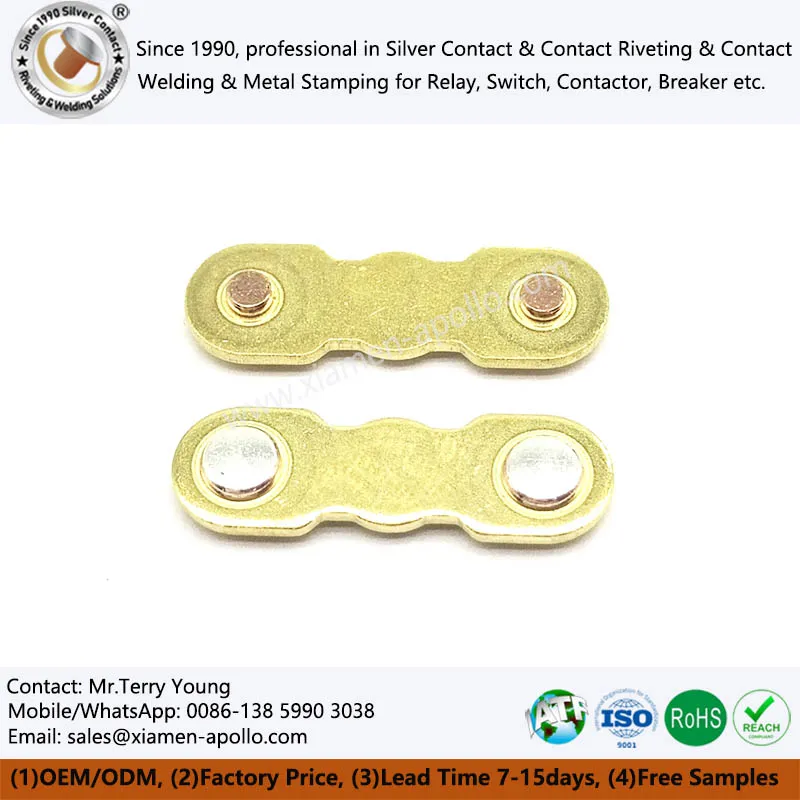
It is against this backdrop that the salt spray test has become a widely adopted method for accelerated corrosion testing. Its fundamental principle involves artificially simulating a high-salinity environment by atomizing a saline solution of a specific concentration and uniformly spraying it within a sealed, temperature-controlled chamber, thereby subjecting the test samples to prolonged exposure in a highly corrosive atmosphere. By observing the changes in appearance, the extent of corrosion, and the performance degradation of products-such as electrical contact rivets made of brass-over a specified period, their corrosion resistance can be rapidly assessed.
For modern electrical products, corrosion resistance has emerged as a critical metric for evaluating product quality. Particularly in the fields of switches, relays, and conductive connection assemblies, components-such as brass-stamped electrical contacts with silver surfaces-are frequently required to withstand the long-term effects of atmospheric humidity, temperature fluctuations, and environmental contaminants. If the materials or surface treatment processes fail to meet established standards, these components become highly susceptible to issues ranging from oxidation and corrosion to outright functional failure.
The primary advantage of the salt spray test lies in its ability to significantly shorten the validation cycle. In natural environments, certain metal components may require a year or even longer to exhibit visible signs of corrosion; however, within an artificially simulated environment, products-such as silver bimetal contacts with brass stampings-can typically yield valuable test results within a mere few hours to a few dozen hours, thereby substantially boosting the efficiency of both R&D and quality validation processes.
While the salt spray test serves as an effective method for the accelerated assessment of corrosion resistance, it is crucial to note that the test results should not be regarded as a direct equivalent to a product's actual service life in real-world environments. Since corrosion behavior is influenced by a complex interplay of factors-including temperature, humidity, atmospheric pollutants, chemical media, and mechanical stress-the performance of products (such as bimetal electrical contact rivets with brass components) within a salt spray environment should be treated as a vital reference point for corrosion resistance, rather than as the sole basis for a comprehensive product evaluation.
From the perspective of corrosion mechanisms, salt spray corrosion is fundamentally an electrochemical process. Chlorides present in the atmosphere constitute the primary corrosive medium; specifically, chloride ions possess exceptional penetrative capabilities, enabling them to breach the oxide films and protective coatings on metal surfaces to react with the underlying metal. For metal components-such as Electrical Contact Assemblies and Brass Stamped Parts-the persistent intrusion of chloride ions continuously degrades the surface passivation layer, thereby accelerating the corrosion process.
In the context of relays and connectors, the corrosion resistance of metal terminals is of paramount importance. Taking Brass Relay Pins as an example: when exposed to humid environments over extended periods-particularly if the surface treatment is inadequate-they become highly susceptible to issues such as oxidative discoloration, diminished electrical conductivity, and reduced mechanical strength. Consequently, salt spray testing has emerged as a vital diagnostic tool for assessing the reliability of such terminals.

With the advancement of precision stamping and automated assembly technologies, an increasing number of products are adopting riveted structures to facilitate electrical connections. For Stamped and Riveted Electrical Brass Press Parts, salt spray testing serves a dual purpose: it not only verifies the corrosion resistance of the base material but also evaluates the stability and long-term reliability of the riveted joints, thereby providing a crucial basis for product design optimization.
Overall, as an efficient method for artificially accelerated corrosion testing, salt spray testing enables the assessment of a product's corrosion resistance within a relatively short timeframe, offering valuable insights for product R&D, material selection, and quality control. For critical components-such as Electrical Contacts with Silver Contact surfaces-that are widely utilized in switches, relays, and connectors, scientifically sound and rigorous salt spray testing not only enhances product reliability but also contributes to boosting overall market competitiveness and customer satisfaction.
If you are currently seeking solutions involving Electrical Contacts with Silver Contact surfaces, we invite you to contact us; we are ready to provide you with expert technical support and comprehensive manufacturing services.
Contact Us
