

Tungsten Contacts for AC Contactor are mainly made of high-purity tungsten or tungsten alloys. Tungsten, a metal, has many excellent properties. Its melting point is extremely high, reaching 3410℃, which enables tungsten contacts to maintain a stable physical form in high-temperature environments. At the same time, it also has good electrical and thermal conductivity, which lays the foundation for its key role in electrical systems.
In the switchgear of electrical systems, Tungsten Contacts for Electrical Contactor is one of the core components. Taking the common AC contactor as an example, the AC contactor is used in the power system to frequently connect and disconnect the AC circuit. When the electromagnetic coil is energized, the moving iron core is attracted, driving the moving contact and the static contact to close, and the circuit is turned on; after the coil is de-energized, the moving contact is separated from the static contact under the action of the spring, cutting off the circuit. During this process, the contacts will be subjected to strong current and arc shock. Tungsten contacts can effectively resist arc ablation due to their high melting point and good arc resistance. The high temperature of the arc will cause general metals to melt or even evaporate quickly, but the surface of tungsten contacts does not easily melt and deform significantly under the high temperature of the arc, thus ensuring that the contacts can still maintain good contact performance after multiple opening and closing operations, ensuring the reliable operation of the AC contactor, and greatly extending the service life of the equipment.

In high-voltage circuit breakers, the role of AC Contactor Tungsten Contact Points cannot be ignored. High-voltage circuit breakers are used to cut off and connect load current and fault current in high-voltage circuits. When a system fails and the current needs to be cut off, a strong arc will be generated. At this time, the arc resistance and high thermal conductivity of tungsten contacts play an important role. It can quickly dissipate the heat generated by the arc to avoid damage to the contacts due to overheating, and effectively suppress the continuous burning of the arc so that the circuit breaker can quickly and reliably cut off the circuit and ensure the safe and stable operation of the high-voltage power system.
In addition to switchgear, iron tungsten rivets for AC contactors are also widely used in some relays and controllers. In these devices, although the current is relatively small, the reliability and stability requirements of the contacts are also very high. The good conductivity of tungsten contacts ensures the accurate transmission of signals, and its excellent wear resistance enables the contacts to maintain stable contact resistance during frequent actions, ensuring the accurate control function of the equipment.
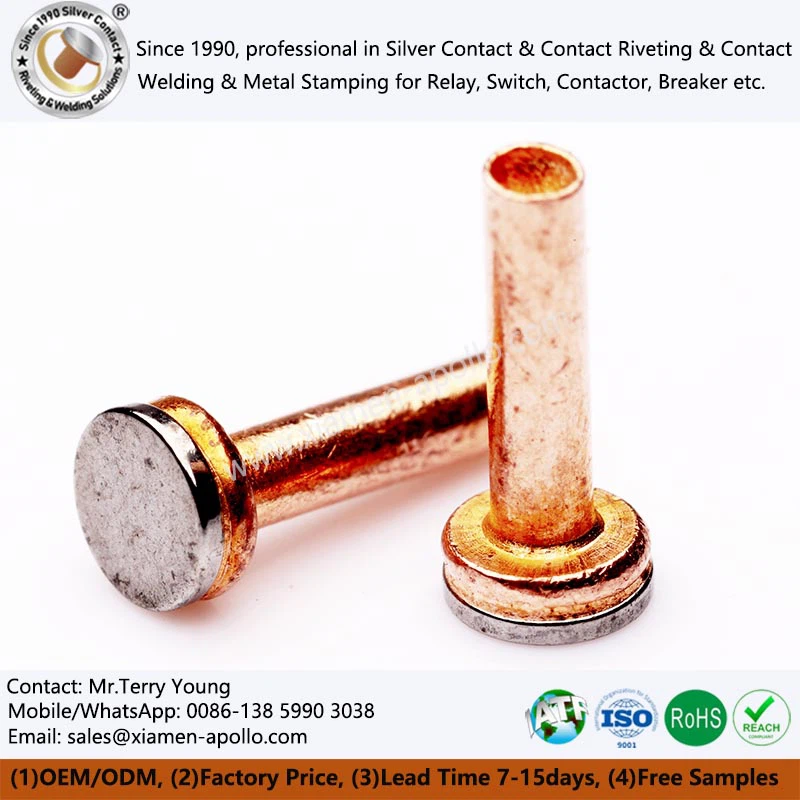
From a macro perspective, the wide application of Tungsten Electrical Contacts for AC Contactor in electrical systems is of great significance to the development of the entire power industry. It improves the performance and reliability of electrical equipment and reduces the maintenance frequency and cost of equipment. In industrial production, a stable and reliable electrical system is the key to ensuring production continuity and product quality, and tungsten contacts provide strong support for this key link. In daily life, whether it is a lighting system, household appliances, or various office appliances, the electrical system behind it cannot be separated from the silent work of tungsten contacts, bringing convenience and comfort to people's lives.
With the continuous advancement of science and technology and the development of electrical systems towards higher voltage, larger current, and more intelligence, higher requirements are also placed on the performance of Tungsten Contacts for AC Contactor. In the future, researchers will continue to explore and improve the materials and manufacturing processes of tungsten contacts, further improve their performance, enable them to better adapt to the evolving needs of electrical systems, and play a more important role in the electrical field.
