

In the field of modern electrical and electronic engineering, achieving reliable, low-resistance, and durable electrical connections between metal components is a fundamental and critical technical challenge. Silver-based brazing technology, as a mature metallurgical joining method, occupies a central position in the manufacture of high-performance electrical contacts and connectors. This article aims to systematically elucidate silver-based brazing technology, particularly focusing on the materials science, process principles, technical advantages, and key quality control points of Brazed Silver Electrical Connectors, providing professional industry knowledge references for engineers and technology decision-makers in related fields.

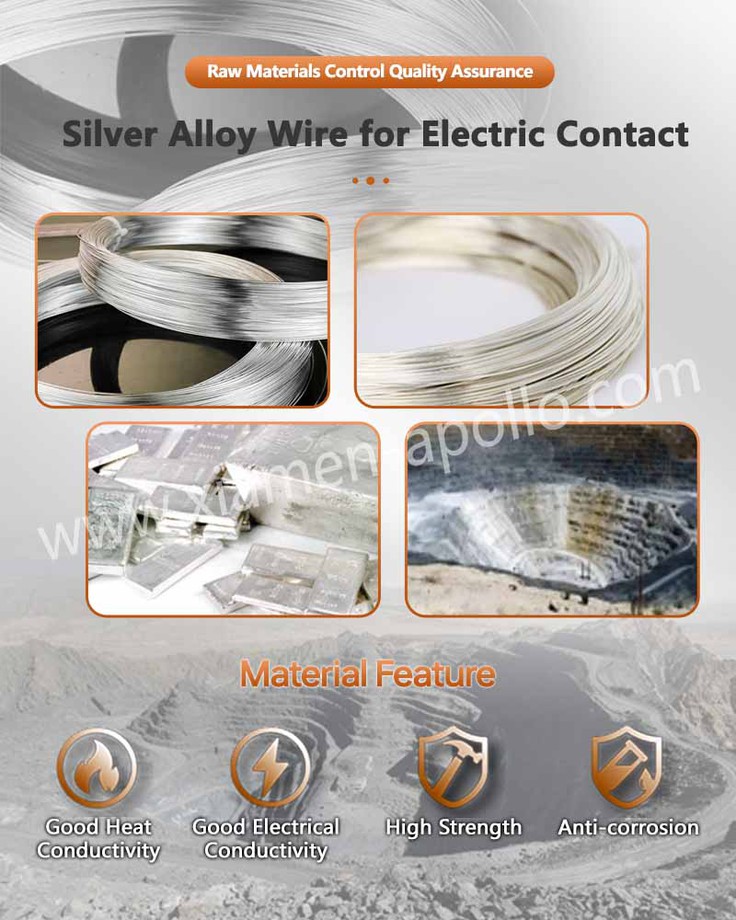
The core of silver-based brazing technology lies in silver alloy solders. Pure silver is highly favored due to its excellent electrical and thermal conductivity, but its high melting point (approximately 960°C) and insufficient strength and creep resistance in certain demanding applications. Therefore, Silver Alloy Brazed Electrical Contacts are widely used in practical engineering. By adding elements such as copper, phosphorus, cadmium, and tin to silver, a series of eutectic or near-eutectic alloys can be formed, significantly reducing the brazing temperature, improving wettability and fluidity, and enhancing the mechanical properties of the joint.
For example, silver-copper eutectic alloys (such as BAg72Cu) are a classic solder with excellent fluidity (often required to be ≥80mm/10s in standard tests). They can form strong connections at temperatures above 600°C but below the melting point of pure silver, easily achieving tensile strengths exceeding 200MPa and exhibiting good resistance to high-temperature oxidation. For applications requiring even lower welding temperatures or flux-free solutions, self-fluxing alloys such as silver-phosphorus and silver-copper-phosphorus are important choices. These carefully designed alloys ensure that Electrical Contacts with Silver Brazing can operate stably in high-current, high-vibration, and wide-temperature environments.
Silver-based joining processes are mainly divided into two categories: fusion welding/brazing requiring the addition of filler metal, and pressure welding relying on resistance heating to achieve the connection.
1. Silver Brazing Process
This is the most widely used process, suitable for scenarios requiring high-temperature and high-strength connections, such as the main contact connections of high-current circuit breakers and contactors. The process typically involves placing a pre-formed Silver Brazing Sheet or brazing ring between the components to be joined. Under a protective atmosphere (such as a mixture of hydrogen and nitrogen) or a suitable amount of flux (whose activity must be strictly controlled, typically ≤0.1% to avoid subsequent corrosion), the material is heated to a temperature above the liquidus line of the filler metal and below the solidus line of the base metal. After the filler metal melts, it fills the joint gap through capillary action, dissolving and diffusing with the base metal, forming a strong metallurgical bond upon cooling. The key to Silver Contact Brazing is precisely controlling the heating profile, protective atmosphere, and cooling rate to minimize the heat-affected zone, avoid degradation of the base metal (such as copper alloys), and ensure the joint is free of defects such as porosity and inclusions.
2. Resistance Welding Process
This is a highly efficient solid-phase or liquid-phase bonding technology, particularly suitable for high-speed automated production. Its principle utilizes the resistance heat generated by the current passing through the contact surface and adjacent areas of the joint to heat the localized metal to a molten or plastic state, simultaneously forming a connection under electrode pressure. In contact manufacturing, the following forms are common:
Spot Welding and Projection Welding: For Spot Welding Silver Contact, the current (typically 5-10kA) is concentrated through a pre-designed small contact point, completing the welding in a very short time (10-50ms) and under a certain electrode pressure (0.5-1.5MPa). Efficiency can exceed 500 pieces/minute, and the joint is internally dense with almost zero porosity.
Butt Welding: Butt Welding Silver Contact is commonly used to weld silver contact material to the end face of a conductive rod. High precision in end face preparation is required to achieve uniform heating and forging effects. Resistance Welding Silver Contact technology has the advantages of highly concentrated heat, fast thermal cycling, and small deformation, making it very suitable for mass production of Silver Welding Connector Contacts.
Butt welding Silver Contact is the cornerstone of building modern, highly reliable electrical connection systems. From the meticulous development of material formulations to the precise control of welding processes and the quality verification throughout the entire process, every step embodies profound knowledge of materials science and engineering practice. As electrical equipment evolves towards higher power density, longer lifespan, and greater adaptability to harsher environments, higher demands are placed on these connection technologies, driving continuous innovation in related materials and processes.
contact us
If you require further discussion on the compatibility conditions, specification selection, or project implementation process of silver contact welding and brazing solutions, please feel free to contact our technical team. We will assist you in completing the engineering assessment and application analysis.
