

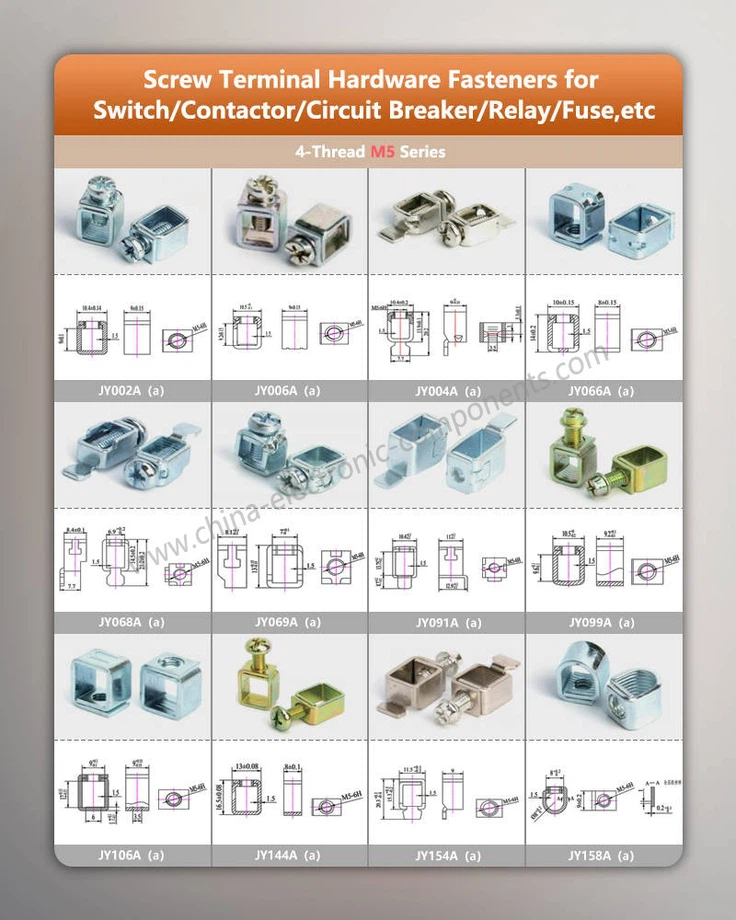
A Clamp Screw is a commonly used electrical connection device. It has threaded holes and is used to secure wires and connect circuits. It generally consists of an insulating base and a metal isolator. The metal isolator is usually a square or round metal core. These are used in various designs and manufacturing methods to connect multiple electrical conductors, thereby transmitting current, signals, and high-voltage loads within the circuit. Screw terminals are widely used in various electrical fields, including distribution boxes, control cabinets, motors, automotive electrical systems, and televisions.
Different types and specifications of Screw Clamp Terminals depend on specific application scenarios and needs. Some screw terminals need to meet waterproof, shockproof, or other environmental requirements, while others have auxiliary functions such as locking mechanisms and indicator lights to meet various user needs.
Key Features of Stamping Screw Terminal Blocks:
Easy to connect and disconnect.
Can be repeatedly connected, reducing damage rate.
Economical and practical, low cost.
Easy to install, can be fixed with screws.
Reliable wiring, not easy to loosen, ensuring connection quality.
Aesthetically pleasing, easy to maintain, and manage.

Function and Role
The function of the Wire Connector Electric Terminal Block is to connect multiple electrical conductors in a circuit. They connect different wires and, by rotating the screw, secure the wires, allowing current and signals to be transmitted in the circuit. Screw terminals can fix various wires, such as copper wire, aluminum wire, bare wire, and wiring, and provide a certain degree of protective insulation to prevent short circuits or other electrical hazards.
Screw Clamp Terminal Blocks are widely used in electrical installation and maintenance. They can be used to connect various devices, such as electrical appliances, circuit boards, and distribution panels, to achieve circuit connection and debugging. Screw terminals are simple to operate, easy to maintain, and reusable, hence their widespread use. At the same time, screw terminals come in different types and specifications to meet the needs of different applications, such as fixed terminals, detachable terminals, pluggable terminals, and DIN rail terminals. Specific requirements and installation methods must be observed when using them.
Main Applications
Screw Clamp Terminals are widely used in electronic, electrical, and communication equipment, generally in power supply circuits, control circuits, and signal circuits. Common applications of screw terminals include:
Power Modules: Used to connect the input and output circuits of power modules, ensuring stable and reliable electrical connections.
Industrial Automation Control Equipment: Stamping Screw Terminal Blocks can be used for electrical connections in industrial automation control equipment, such as robots and automated production lines.
Communication Equipment: Used for connecting circuits in telecommunications modules and terminal equipment of communication equipment.
Home Appliances: Can be used for connecting control circuits and power supply circuits in home appliances.
Lighting Equipment: Used for circuit connections in LED lighting equipment, such as LED light strips and LED driver power supplies.
Automotive Electronics: Used for circuit connections in automotive electronic equipment, such as car audio systems and headlights.
Advantages and Disadvantages: Wire Connector Electric Terminal Blocks, as a common electrical connection method, have the following main advantages and disadvantages.
Advantages and Disadvantages
Advantages:
Safe and Reliable: Screw Clamp Terminal Blocks can stably clamp wires, are not easily affected by external interference, and have high contact reliability and corrosion resistance.
Easy to Maintain: Screw Clamp Terminal connections are relatively simple, easy to maintain, and replace.
Strong Applicability: Stamping Screw Terminal Blocks support different wire specifications and are suitable for various electrical connection needs.
Disadvantages:
Installation is Troublesome: Compared to plug-in terminals, Wire Connector Electric Terminal Blocks require a screwdriver for tightening, making installation relatively more troublesome.
Larger Space Occupancy: Screw Clamp Terminal Blocks usually require a larger space, making them unsuitable for use in circuits with limited space.
Higher Cost: Compared to other electrical connection methods, the Clamp Screw may be slightly more expensive.
contact us
