

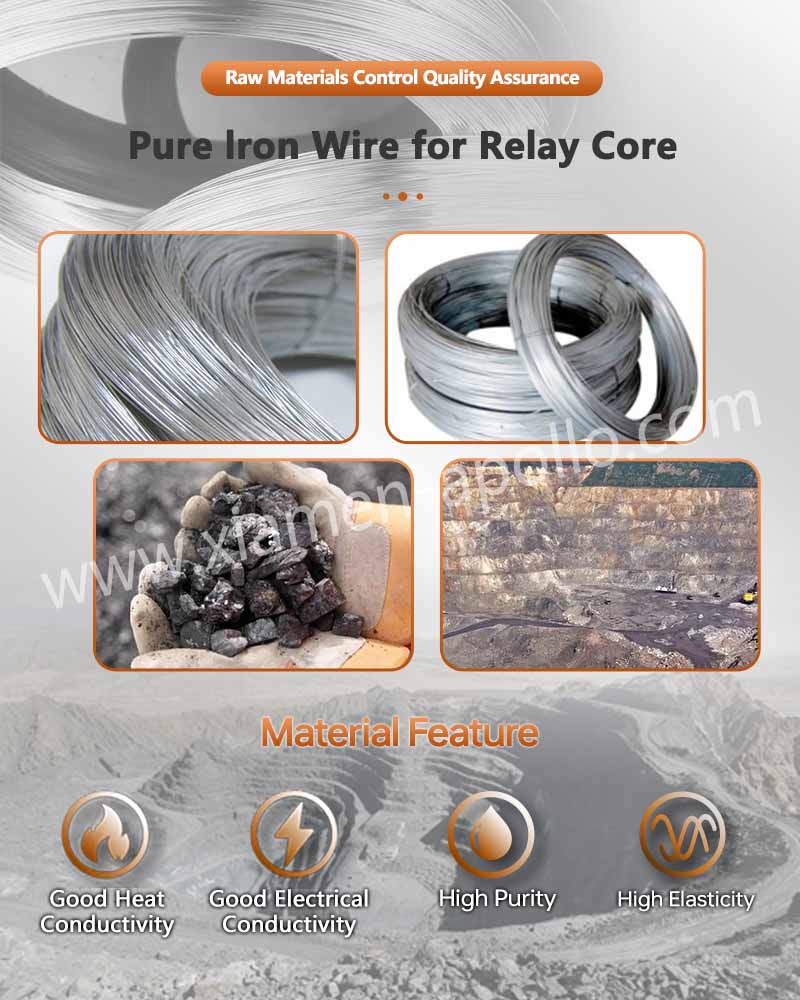
Pure Iron Magnetic Cores in high-voltage DC (HVDC) contactors and relays function as the primary flux-conduction conduits that convert coil electromagnetic energy into mechanical contact actuation force under IEC 60947 operational parameters. Manufactured primarily from ultra-low-carbon DT4 series electromagnetic pure iron, these components achieve an initial magnetic permeability greater than or equal to 4.0 × 10^-3 H/m, coercive force less than or equal to 60 A/m, and residual induction less than or equal to 0.1 T, preventing armature sticking during high-frequency switching cycles.

Electromagnetic Architecture and Core Operating Dynamics in HVDC Relays
An HVDC relay assembly relies on the synergistic interaction of four core subsystems: the magnetic coil, the core/armature, the contact bridge system, and the arc-extinguishing chamber. When a DC control voltage is applied to the copper winding, magnetomotive force generates a concentrated magnetic flux through the Precision Relay Core.
The operational sequence proceeds through four distinct physical phases:
- Control Signal Input: DC excitation current enters the multi-turn copper coil, establishing a localized magnetic field vector.
- Magnetic Flux Conduction: The Relay Magnetic Core channels the flux lines across the working air gap, generating a high mechanical attractive force.
- Contact Actuation: The magnetic force overcomes the opposing contact spring preload greater than or equal to 12 N, closing the main circuit contacts within less than or equal to 15 ms.
- Demagnetization and Reset: Circuit signal termination drops coil current to zero; low core coercivity facilitates rapid flux collapse and spring-assisted armature return.
| Parameter / Feature | AC Laminated Silicon Steel Core | DC DT4 Pure Iron Core (Xiamen Apollo Standard) |
|---|---|---|
| Primary Material | Fe-Si alloy laminations (0.35 mm / 0.5 mm) | Forged / Cold-headed DT4 / DT4E electromagnetic iron |
| Saturation Induction (Bs) | 1.60 T – 1.65 T | 2.15 T – 2.20 T |
| Coercive Force (Hc) | 80 A/m – 120 A/m | Less than or equal to 60 A/m |
| Core Loss at 50Hz/1T | Low eddy-current loss via insulation coatings | Optimized for steady DC magnetic circuits |
| Mechanical Formability | Limited to stamping and stacking | High ductility for cold heading, machining, and riveting |
Consult Our Electrical Engineers Today

Metallurgy and Chemical Composition of DT4 Electromagnetic Iron for DT4C Magnetic Iron Core
Material purity dictates soft magnetic performance. Impurities such as carbon, nitrogen, sulfur, and phosphorus act as pinning sites for magnetic domain walls, which degrade permeability and increase hysteresis loss. Xiamen Apollo utilizes vacuum-induction-melted DT4, DT4A, DT4E, and DT4C series pure iron conforming to GB/T 6983 standards.
| Grade | Max Carbon (C %) | Max Manganese (Mn %) | Max Phosphorus (P %) | Max Sulfur (S %) | Max Nitrogen (N %) | Application Focus in Relays |
|---|---|---|---|---|---|---|
| DT4 | 0.005 | 0.25 | 0.020 | 0.020 | 0.008 | Standard DC power relays and general solenoids |
| DT4A | 0.004 | 0.20 | 0.015 | 0.015 | 0.006 | Automotive HVDC contactors requiring quick release |
| DT4E | 0.003 | 0.15 | 0.010 | 0.010 | 0.005 | High-sensitivity industrial and aerospace relays |
| DT4C | 0.002 | 0.10 | 0.005 | 0.005 | 0.004 | Ultra-low residual magnetism precision contactors |
Precision Forming and Vacuum Magnetic Annealing Methodologies for Relay Magnetic Core
Raw material metallurgy alone is insufficient without controlled thermomechanical processing. Stamping and cold-heading induce severe lattice dislocations and internal mechanical stresses, which spike coercive force by up to 300% if unaddressed.
- Cold-Heading & Progressive Stamping: Rods of DT4 iron are cold-formed into Soft Magnetic Iron Rod, yokes, and T-poles with dimensional tolerances controlled to plus or minus 0.005 mm.
- High-Frequency Vacuum Annealing: Formed components undergo batch thermal treatment in a hydrogen-nitrogen protective atmosphere at 880°C for a 2-hour soak period, followed by controlled furnace cooling. This recrystallizes the metal matrix, enlarges grain size to greater than or equal to Grade 4 (ASTM E112), and restores optimal soft magnetic properties. Post-Annealing Handling: Zero-impact automated transfer prevents work hardening before protective surface finishing.

Dimensional Tolerances, Surface Protective Coatings, and Quality Assurance of Relay Core
Operating environments in electric vehicles (EV battery packs) and industrial solar inverters demand resistance to thermal cycling (-40°C to +125°C) and salt fog exposure. Xiamen Apollo Electric implements strict Quality Management Systems certified to IATF 16949:2016 and ISO 9001:2015.
| Plating / Coating Type | Layer Thickness | Salt Spray Resistance (ASTM B117) | Magnetic Impact | Recommended Use Case |
|---|---|---|---|---|
| Electroplated Zinc (Zn) | 8μm−12μm | ≥96 hours to white rust | Negligible | Standard industrial DC contactors |
| Zinc-Nickel Alloy (Zn-Ni) | 8μm−10μm | ≥720 hours to red rust | Negligible | EV battery disconnect & marine relays |
| Electroless Nickel (ENP) | 5μm−8μm | ≥500 hours | Minor permeability shift | High-wear mechanical pivot faces |
| Passivated / Unplated (Oiled) | N/A (Anti-corrosion oil film) | N/A (Sealed housing required) | Maximum initial permeability | Hermetically sealed or inert-gas relays |

contact us
Submit your 2D/3D CAD drawings of Pure Iron Magnetic Core to the Xiamen Apollo engineering department today to receive a comprehensive DFM review and sample quotation within 24 hours.
