

In the modern industrial process, welding technology is like a bridge, connecting various materials and promoting the development of multiple industries. Silver Contact Welded Assemblies play an important role in the field of electronic and electrical connections. Their efficient connection lays the foundation for the stable operation of electrical equipment. From the initial simple manual welding to the highly intelligent and automated advanced process today, the evolution of welding technology is the continuous accumulation of human industrial wisdom.

Welding is essentially a process method that achieves a close bond between the atoms of the workpiece by heating, pressurizing, or the synergy of the two, with or without filler materials. Brazing Electrical Contacts uses a similar atomic bonding principle and uses brazing technology to connect silver contacts with other components at the atomic level to ensure the stability of electrical performance. In actual operation, due to interference factors such as unevenness, oxide film, and oil pollution on the surface of the material, a series of specific technical means are needed to overcome them to ensure the quality of welding.
Welding technology has a very long history. As early as 3000 BC, traces of brazing welds were found on the bronze chariot components unearthed from the Terracotta Warriors of Qin Shihuang, and forging welding technology was also used in ancient Egypt during the same period. As time goes by, welding technology continues to innovate. From the late 19th century to the early 20th century, the emergence of arc welding methods marked a new stage of development for welding technology. Since then, a series of advanced welding technologies such as submerged arc welding, gas-shielded arc welding, laser welding, and electron beam welding have emerged one after another, meeting the diverse needs of different industries for material connections. Electrical Contact Resistance Brazing also came into being in the tide of the continuous development of welding technology, meeting the needs of the electronic and electrical field for high-precision connections.
There are many types of welding technologies, which are mainly divided into three categories: fusion welding, pressure welding, and brazing. Fusion welding is to melt the base material and filler material by heating them to form a molten pool and then connecting them after cooling. Common arc welding, submerged arc welding, gas shielded arc welding, etc. belong to this category; pressure welding is to connect the materials in a solid state by heating or not heating while applying pressure, including resistance welding, friction welding, etc.; brazing is to use brazing material with a lower melting point than the base material. When heated to a temperature lower than the melting point of the base material but higher than the melting point of the brazing material, the brazing material melts and fills the gap in the base material to achieve connection. Projection Welding Silver Contact is a typical application of brazing technology. With good conductivity and arc erosion resistance, Brazed Electrical Contacts are accurately connected to other components through the brazing process, playing a key role in relays, switches, and other components, ensuring the stable operation of electrical equipment and reliable transmission and control of current.

In modern industry, welding technology is widely used in many fields such as aerospace, automobile manufacturing, shipbuilding, construction engineering, and electronic equipment. In the aerospace field, welding technology is used to manufacture aircraft fuselages, engine components, etc., requiring welds to have extremely high strength and reliability; in automobile manufacturing, the welding process determines the structural strength and safety of the car body; in shipbuilding, the welding quality directly affects the service life and navigation safety of the ship. In the field of electronic equipment, the application of Welding Electrical Silver Contact Tip Assembly ensures a reliable connection between electronic components and guarantees the performance of electronic products.
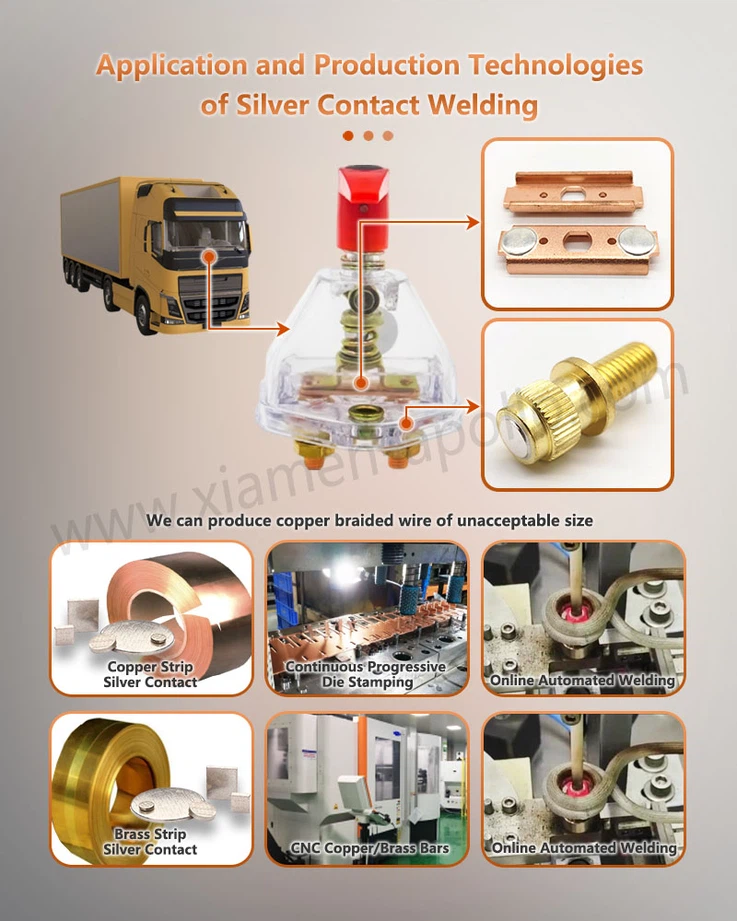
With the continuous advancement of science and technology, welding technology is also developing in the direction of intelligence, automation, and greening. Intelligent welding equipment can monitor various parameters in the welding process in real-time through sensors, and automatically adjust the welding process to improve welding quality and efficiency; the application of automated welding production lines greatly reduces manual operations, reduces labor intensity, and improves production consistency and stability; green welding technology focuses on reducing environmental pollution and energy consumption in the welding process, which meets the requirements of sustainable development. The production process of Electric Resistance Welding Silver Contact is also developing in a more environmentally friendly and efficient direction to adapt to the overall development trend of the industry.
As the core force of industrial connection, welding technology plays an important role in promoting the development of modern industry. In the future, with the continuous innovation and breakthrough of technology, welding technology will show greater potential in more fields and make greater contributions to the progress of human society. Brazing Silver Electrical Contacts will also continue to optimize its performance and expand application scenarios in the continuous development of welding technology.
contact us
