

In modern relay manufacturing, the stability, conductivity, and mechanical life of contact components directly determine the overall reliability of the product. With the rapid development of new energy vehicles, industrial automation, and intelligent control equipment, the internal structure of relays is evolving towards miniaturization, longer lifespan, and higher consistency. Especially in high-speed automated production, ensuring the positional accuracy and long-term stability of contact components has become a core issue in precision manufacturing. To address this need, automated riveting processes based on multi-station progressive dies have gradually become the mainstream solution in the industry, and the structural design of Silver Contact Riveted Assembly has therefore received widespread attention.
A Relay Moveable Spring Riveting Assembly typically consists of a spring and contacts. The contact material is often made of silver-nickel alloy or silver oxide to meet the requirements of low contact resistance and resistance to arc erosion. The spring material is often beryllium copper or phosphor bronze to ensure good elasticity and fatigue life. Under high-frequency switching conditions, the contacts not only conduct electricity but also need to maintain long-term stable mechanical movement; therefore, the assembly precision requirements are extremely high. Especially in high-speed relays, the integrated stamping solution using Stamping Electrical Contacts can effectively reduce assembly errors and improve mass production efficiency.
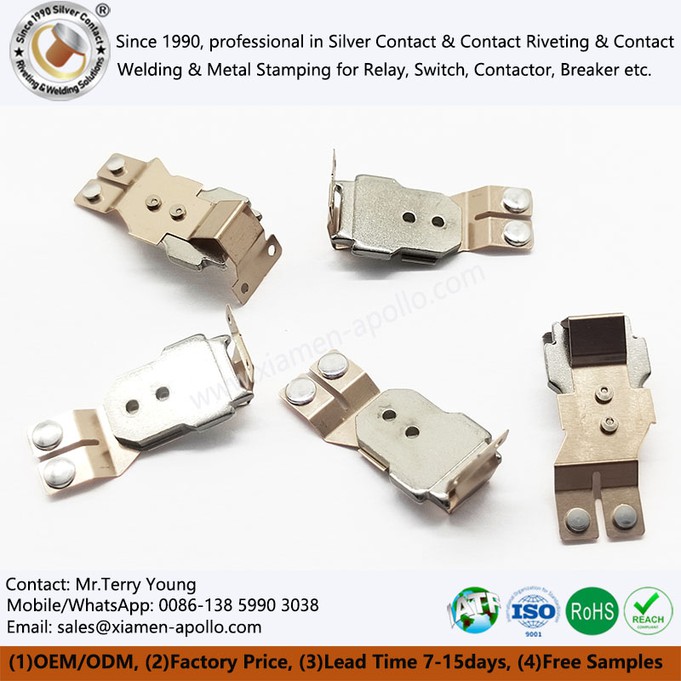
Traditional relay contact assembly largely relies on manual positioning and subsequent calibration processes, which not only limits production efficiency but also easily leads to problems such as contact misalignment, weak riveting, or unstable angles. Especially for ultra-thin elastic springs, uneven transitions at the bending points can cause fatigue fracture later. To solve these problems, multi-station progressive dies are gradually becoming an important process solution in high-end relay manufacturing. By integrating stamping, pre-riveting, shaping, trimming, and bending processes into a single die, the consistency and stability of the Electrical Stamping Contact for Relay can be significantly improved.
In automated progressive die design, the layout scheme is a key factor affecting the stability of subsequent processes. Because the moving spring material has a distinct grain direction requirement, the strip feed direction must be consistent with the part's unfolding direction to avoid subsequent deformation due to material stress changes. Simultaneously, to facilitate automatic contact feeding, the contacts are typically introduced from below the strip and enter the pre-riveting area at a specific angle. This design not only improves feeding efficiency but also ensures the positional accuracy of the Electrical Stamping Contact Components.
In the pre-riveting station, the contact rod first passes through the spring hole, achieving initial fixation through slight deformation. The main purpose of this step is not to establish final riveting strength, but to ensure stable positioning of the contact during subsequent feeding. Insufficient pre-riveting deformation may cause the contact to detach during transport; excessive deformation can easily affect subsequent precision shaping. Therefore, the dimensional control of the pre-riveting punch is extremely important, and this process is one of the core processes in the manufacturing of Metal Parts Silver Contact components.
After pre-riveting, the strip material enters the formal pressing station. At this stage, the upper and lower dies precisely press the contacts together, firmly bonding the silver-based contacts to the spring. Since relay contacts need to withstand frequent current surges, riveting strength and conductivity stability are crucial. Especially in automotive and industrial control relays, the use of a composite structure of Silver/Copper Metal Parts for Switch and Relay can balance conductivity and mechanical strength.
To improve the stability of automated production, modern progressive dies typically employ a dual-guide structure design. External mold base guide pillars are responsible for overall mold positioning, while internal ball bearing guide pillars further improve stamping accuracy. This dual-guiding method effectively reduces offset errors during high-speed stamping, thereby improving the dimensional consistency of the Armature Beryllium Copper Riveting Assembly.
In the contact feeding system, the coordinated control of the vibrating hopper and pneumatic feeding mechanism is equally crucial. After the contacts are automatically aligned by the vibrating platen, they enter the feeding channel via guide rails, and then a cylinder drives a pull rod to deliver the contacts to the pre-riveting position. The entire process is usually coordinated with a photoelectric detection system to achieve material shortage alarms and automatic shutdown functions. This approach not only improves the level of automation but also effectively reduces the defect rate of Beryllium Copper Punch Contact Riveted Terminals.
Due to the high elasticity and resilience of beryllium copper, the bending angle control requirements in the subsequent bending station are extremely high. If the mold design is unreasonable, indentations or stress concentrations can easily form in the bending area, thus affecting long-term fatigue life. Therefore, in actual production, a large rounded corner transition design is often adopted to ensure the stability of the Beryllium Copper Stamping Spring during long-term operation.
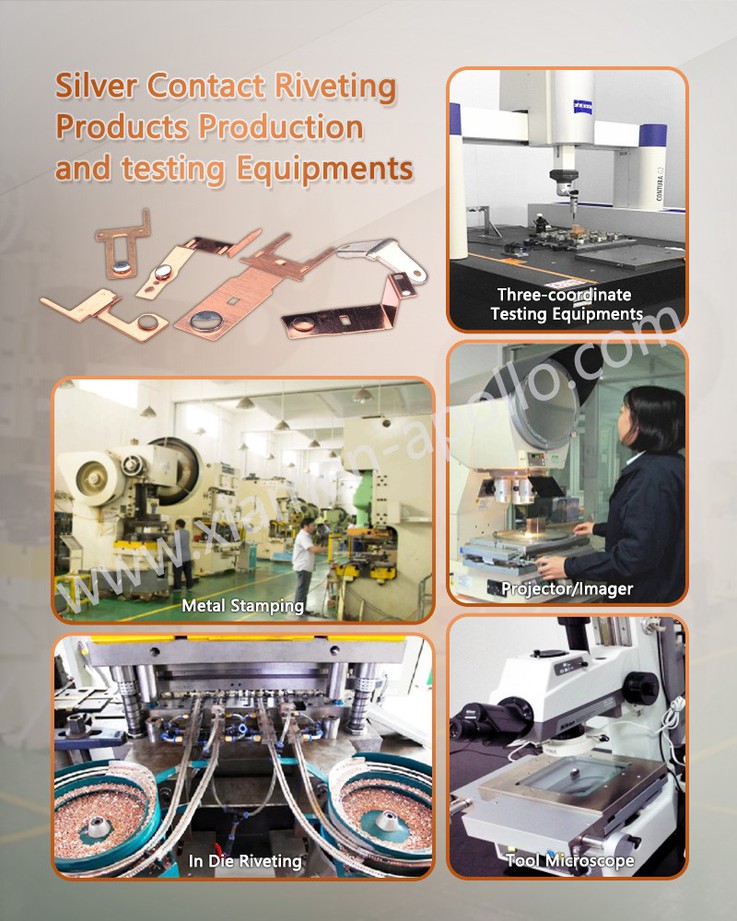
Against the backdrop of rapid development in the relay industry, the structural optimization and automated manufacturing level of Silver Contact and Stamping have become crucial factors determining product competitiveness. Especially for high-lifespan, high-frequency relays, precision in-mold riveting not only improves conductivity reliability but also reduces the risk of later maintenance and failure. Therefore, the high-precision process using In-Die Rivet Electrical Contacts will continue to be a key development direction for the industry.
From an industry trend perspective, future relay manufacturing will place greater emphasis on high-speed automation, miniaturization, and intelligence. The deep integration of multi-station progressive dies and automated riveting processes can not only improve production efficiency but also significantly reduce material waste and manufacturing costs. Particularly in the fields of new energy, automotive electronics, and industrial automation, the market demand for precision connection solutions based on Riveted Electrical Connection Components will continue to grow.
Overall, the combination of automated riveting processes and multi-station progressive die technology not only solves the efficiency and consistency problems in traditional assembly but also drives the relay industry towards high reliability and intelligent manufacturing. In the future field of precision electronics manufacturing, automated processing technology surrounding Relay Moving Springs will continue to be an important direction for industry research and innovation.
If you are looking for Silver Contact Riveting Assembly solutions or customized stamping products, please contact us for more technical support and product information. We will provide you with professional and efficient manufacturing solutions.
Contact Us
