

Against the backdrop of continuous upgrading in high-end equipment and precision electrical systems, Copper Alloys Metal Stamping is becoming an essential basic component supporting operations across multiple industries. Featuring excellent electrical and thermal conductivity, good plastic workability, and stable corrosion resistance, these copper strip stamped structural parts are widely used in automotive, electrical control, electronic connection, and industrial equipment sectors. The industry generally agrees that material purity control and stamping precision are the core factors ensuring the long-term reliable performance of Electrical Metal Stamping.
In terms of material properties, industrially pure copper is an ideal choice due to its high purity and stable microstructure. Oxygen-free copper with a purity of over 99.9% offers conductivity close to the International Annealed Copper Standard (IACS), effectively reducing energy loss and temperature rise risks during current transmission. Meanwhile, its high elongation makes it suitable for deep stamping and complex bending processes, meeting diverse engineering design requirements. The dense oxide layer formed in natural environments provides basic corrosion resistance, laying a stable foundation for the long-term use of electrical connection structures.
In manufacturing, the production of Copper Pressed Stamped Parts emphasizes full-process control. Before production, materials are selected with appropriate hardness to balance formability and strength according to structural needs. Mold design optimizes clearance and fillet parameters based on material flow characteristics to ensure cutting-edge quality and dimensional stability. Control over pressure and temperature during stamping is critical to avoid microstructure changes that affect performance. Subsequent cleaning and necessary surface treatments improve appearance quality and environmental adaptability, meeting high-precision assembly requirements.
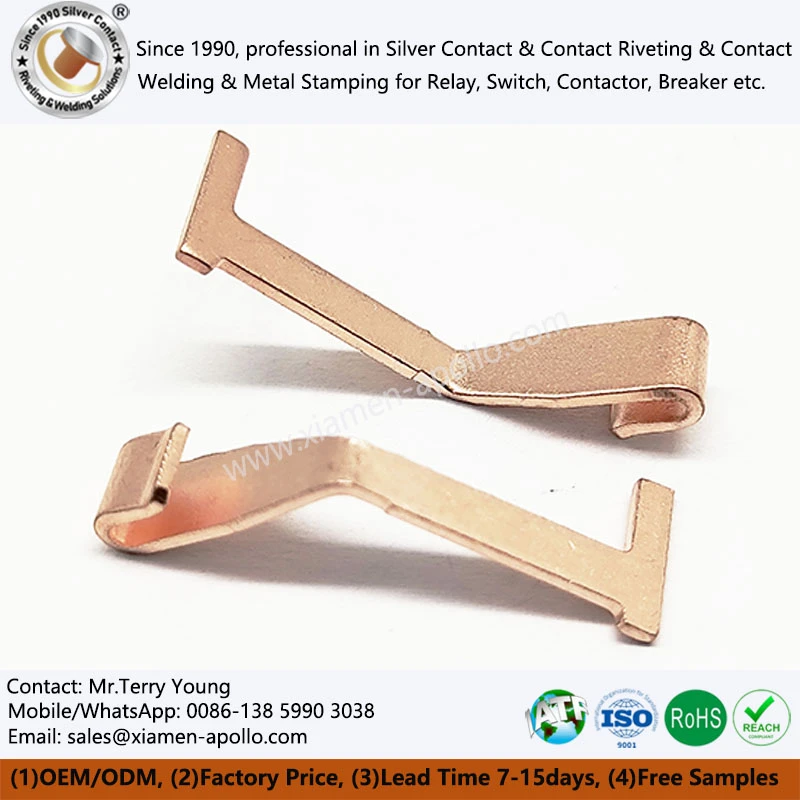
From an application perspective, Copper Alloys Metal Stamping has been deeply integrated into multiple core industries. In the automotive sector, such stampings are commonly used in heat dissipation systems, motor conductive rings, and electrical connections. Especially in the drive systems of new energy vehicles, requirements for thermal stability and dimensional accuracy of high-conductivity structural components keep rising. In the electronics and electrical industry, key parts such as connector springs, terminals, and circuit board conductive sheets widely adopt Stamping Riveting Electrical Copper Press Parts For Switch Socket, whose stable conductivity directly determines signal transmission quality and contact reliability.
Furthermore, in home appliances and industrial control equipment, air conditioning pipeline connectors, heat dissipation components, and internal conductive parts of control modules also rely on the stable support of Copper Strip Stamping. As products develop toward higher power density and miniaturization, requirements for material consistency and stamping precision continue to increase. Some architectural decoration and chemical equipment fields have also gradually adopted copper stampings to meet corrosion resistance and long-term operation needs in complex environments. It can be said that despite their small size, Switch Socket Precision Custom Metal Stamping Parts play an irreplaceable fundamental role in multiple industrial chains.
In quality management, the industry usually adopts multi-dimensional control methods including dimensional inspection, composition analysis, mechanical property testing, and environmental adaptability verification, to ensure batch stability and long-term reliability. With the advancement of digital manufacturing, the production and inspection of Copper Alloys Metal Stamping are moving toward digitization and traceability, providing more stable quality assurance for high-end applications.

Based on the above application scenarios, high-purity Copper Alloys Metal Stamping solutions are often adopted in the development of new energy vehicle electronic control systems and high-frequency connection modules. Such products are systematically optimized in material matching, cross-section design, and surface treatment for high-current loads and long-term thermal cycling conditions. For further details on parameter ranges and applicable working conditions, please click the link below for professional consultation.
Contact Us
