

With the continuous improvement of industrial automation and the increasing integration of electronic equipment, the performance of electrical contact materials is directly related to the stability and service life of circuit systems. Among various contact materials, Pure Silver Contacts have become indispensable core components in switches, relays and control modules due to their unique physical properties and electrical advantages. This paper systematically analyzes the industrial value of Electrical Contacts from the dimensions of material properties, typical applications, technical evolution and selection logic.
Pure silver is an important choice for electrical contact materials owing to its many outstanding physical properties. Firstly, silver has the highest electrical conductivity among all metals, reaching 6.3×10⁷ S/m. This property effectively reduces energy loss and ensures circuit response sensitivity in high-frequency signal transmission and precision control scenarios. Secondly, silver oxide formed during arc erosion still maintains good conductivity and can be reduced back to metallic silver in subsequent switching operations, realizing the self-cleaning function of contacts and greatly reducing the risk of contact resistance fluctuation. In addition, silver has a thermal conductivity of 429 W/(m·K), which can quickly dissipate Joule heat generated during contact closing, preventing material welding or degradation caused by local overheating, and ensuring long-term stable operation under frequent switching conditions.

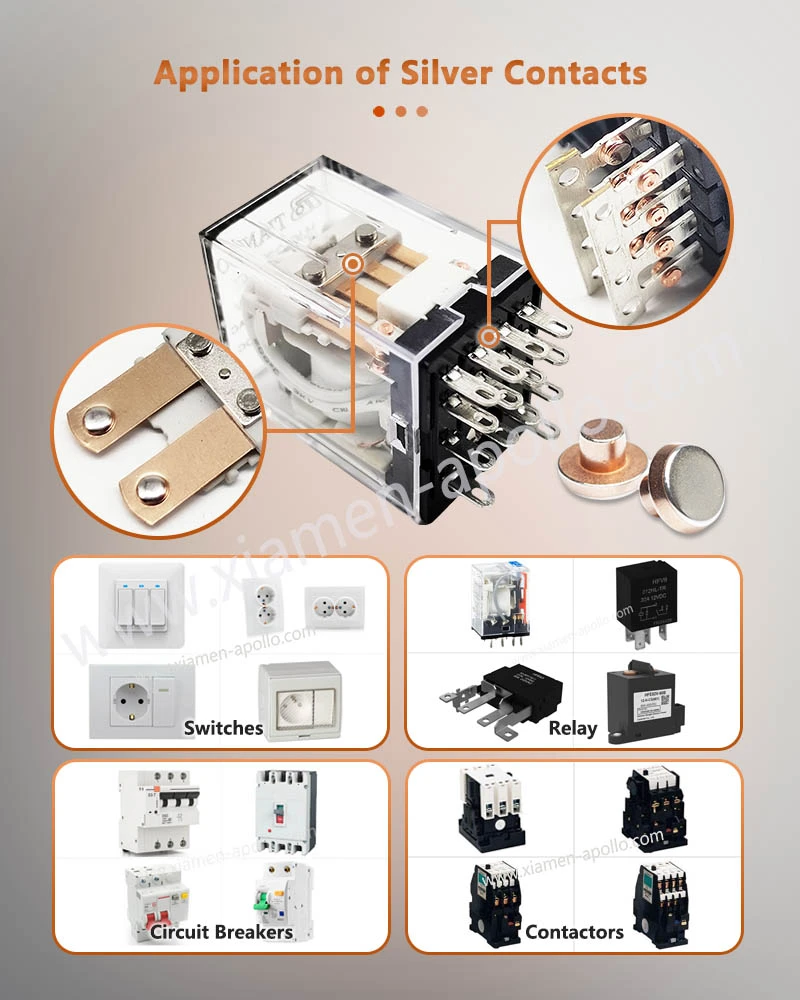
In the field of consumer electronics and household appliances, the application of Pure Silver Contacts covers almost all kinds of switches and control circuits. Taking rocker switches, power switches and relays as examples, the silver layer thickness at the contact directly affects the electrical life of products. In general applications, the silver layer thickness is usually 0.2–0.3 mm, while in industrial or high-end products with high reliability requirements, it can reach more than 0.5 mm. In addition, in the control boards of microwave ovens, air conditioners and other home appliances, Solid Contacts are used for switching signal circuits. Their low and stable contact resistance helps ensure accurate transmission of control signals and avoid system malfunction caused by poor contact.
With the acceleration of vehicle electrification and intelligence, the complexity and harsh working environment of automotive electronic systems have increased simultaneously. Relying on their vibration resistance, arc resistance and long-term stability, Electronic Contacts are widely used in ABS systems, engine control units and various sensor interfaces. In high-frequency operating parts such as window lift switches and light adjustment switches, Contact in Electrical can withstand more than one million switching cycles, ensuring the reliability of the entire vehicle electrical system. In the industrial control field, Pure Silver Contacts also undertake the key task of high-current making and breaking in CJX series contactors, molded case circuit breakers and PLC I/O modules, whose thermal and electrical conductivity directly affect the response speed and safety margin of equipment.
To meet the challenges of higher power density and more complex working conditions, the technology of Electrical Contact Switch is continuously evolving towards material compositing and structural precision. The introduction of nano-silver technology effectively improves the anti-welding ability and mechanical wear resistance of contacts. By adjusting the micro-morphology and distribution density of silver particles, the contact life can be extended without sacrificing electrical conductivity. Meanwhile, composite coating structures such as nickel underplating silver or silver/graphite composite layers have gradually become mainstream, which not only inhibit silver migration under high temperature and high humidity, but also enhance resistance to sulfidation corrosion. On the manufacturing side, the application of powder metallurgy technology has significantly improved the density and composition uniformity of contact materials, while laser welding technology realizes seamless connection between contacts and contact bridges, fundamentally reducing the additional resistance of the contact interface.
As global environmental regulations on hazardous substances become increasingly strict, traditional cadmium-containing silver contacts are gradually being replaced by cadmium-free materials. Silver tin oxide (AgSnO₂) has been widely used in main contacts of automotive relays and household appliances due to its excellent arc erosion resistance and environmental friendliness. Meanwhile, the rapid development of new energy vehicles, smart homes and industrial IoT devices continues to drive up the demand for high-performance electrical contact materials. According to market feedback, contact suppliers with composite structure design capability and refined process control are gradually becoming key supporting links in the industrial chain.
In actual engineering projects, the selection of Single Silver Contacts needs to comprehensively consider multiple factors such as current rating, switching frequency, ambient temperature and medium conditions. For applications carrying high current continuously or suffering frequent thermal cycling shocks, priority should be given to contact structures with sufficient silver layer thickness, strong substrate adhesion and composite coating protection. The matching design of contact cross-section shape and contact pressure cannot be ignored either. A reasonable geometric configuration helps optimize the arc movement path and reduce material loss. Based on the above application scenarios, in engineering practice under high current and long-term thermal cycling conditions, we usually select Pure Silver Contacts with optimized materials and structures. Such products have undergone systematic engineering optimization in cross-section design, surface treatment and composite processes, and can better adapt to the requirements of harsh electrical environments. For further information on their parameter ranges and applicable working conditions, please click the link below for professional consultation.
Contact Us
