

AC relays are essential control components commonly found in industrial automation, power control systems, and household appliances; they are primarily utilized to facilitate functions such as automatic circuit switching, disconnection, protection, and signal conversion. With the advancement of smart devices and automated control systems, the application of relays has become increasingly widespread across low-voltage electrical apparatus, smart home appliances, and industrial control equipment. Consequently, a high-quality Relay Core directly impacts a relay's magnetic conductivity and operational stability.
The fundamental operating principle of an AC relay involves energizing an electromagnetic coil to generate a magnetic field, which attracts an armature to move, thereby actuating the contacts to switch the circuit. When power to the coil is interrupted, the armature returns to its original position under the force of a spring, and the contacts revert to their initial state. Because relays enable the control of high-current circuits using low-current signals, they are extensively employed in automated control systems; furthermore, a premium Pure Iron Core for AC Relays can effectively enhance magnetic permeability and response speed, thereby boosting the relay's overall operational efficiency.
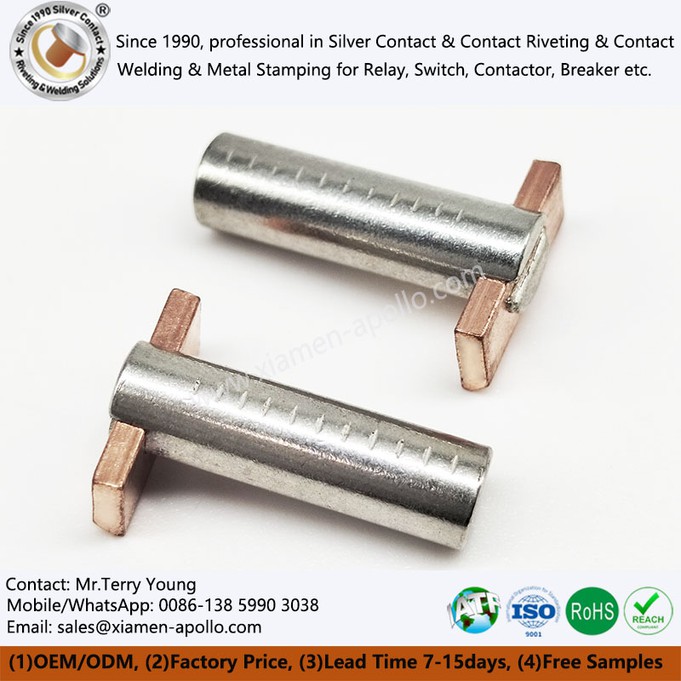
In practical applications, AC relays typically consist of a coil, an iron core, a contact system, and an enclosure. Among these components, the iron core plays a crucial role in conducting magnetic flux; consequently, the manufacturing process and material precision are of paramount importance. The use of a precision-machined Grooved Core for AC Relay effectively minimizes magnetic losses and enhances the stability and durability of the AC relay under conditions of frequent operation, making it particularly well-suited for industrial automation and high-frequency switching equipment.
The wiring methods for AC relays are primarily categorized into two major types: transistor output wiring and NPN-type output wiring. In the transistor output mode, the control terminal drives the relay coil-typically via power devices such as MOSFETs-thereby enabling the control of AC loads. This method is widely employed in PLCs, smart controllers, and embedded systems; in this context, a highly stable AC Relay Core and Copper Ring assembly effectively mitigates AC noise and magnetic vibration, thereby enhancing the operational smoothness of the relay.
The NPN-type output wiring method is predominantly utilized in industrial control systems. It is characterized by the output terminal providing low-level control: VCC connects to the positive terminal of the power supply, GND connects to the negative terminal, and the relay is actuated when the output terminal conducts current. This control method features a simple structure and high stability, finding widespread application in industrial control cabinets and automated machinery. To optimize magnetic permeability and mechanical strength, many manufacturers adopt high-precision Core AC structures to meet the rigorous demands of long-term, continuous operation.
In the realm of home appliances, AC relays also play a pivotal role. For instance, the heating control system within a smart rice cooker typically relies on the collaborative operation of a temperature sensor, a microcontroller, and a relay. When the control chip detects that heating is required, it outputs a high-level signal to a driving transistor; upon receiving power, the relay coil energizes and pulls in, causing the normally open contacts to close-thereby connecting the 220V AC power supply and activating the heating element. In such applications, a Coil Core for Electromagnetic Relay featuring high magnetic permeability serves to enhance pull-in efficiency and mitigate issues related to heat generation.
Beyond their primary control functions, relays also serve a vital role in circuit protection. Should a device encounter conditions such as overload, undervoltage, or other anomalies, the relay can rapidly interrupt the circuit, thereby preventing damage to the equipment. Consequently, in industrial machinery, power distribution systems, and new energy equipment, the relay stands as an indispensable and critical component. To ensure stable operation under high-load conditions, certain products incorporate an AC Core for Industrial Relay design to enhance mechanical strength and fatigue resistance.
In the relay manufacturing process, the choice of core material and the associated processing techniques directly determine product quality. Common materials include pure iron, electrical steel, and soft magnetic alloys; among these, pure iron stands out for its exceptional magnetic permeability and is therefore widely utilized in high-performance relays. Cores fabricated using precision-grade pure iron effectively minimize residual magnetism, thereby enhancing the relay's operational sensitivity and extending its service life.
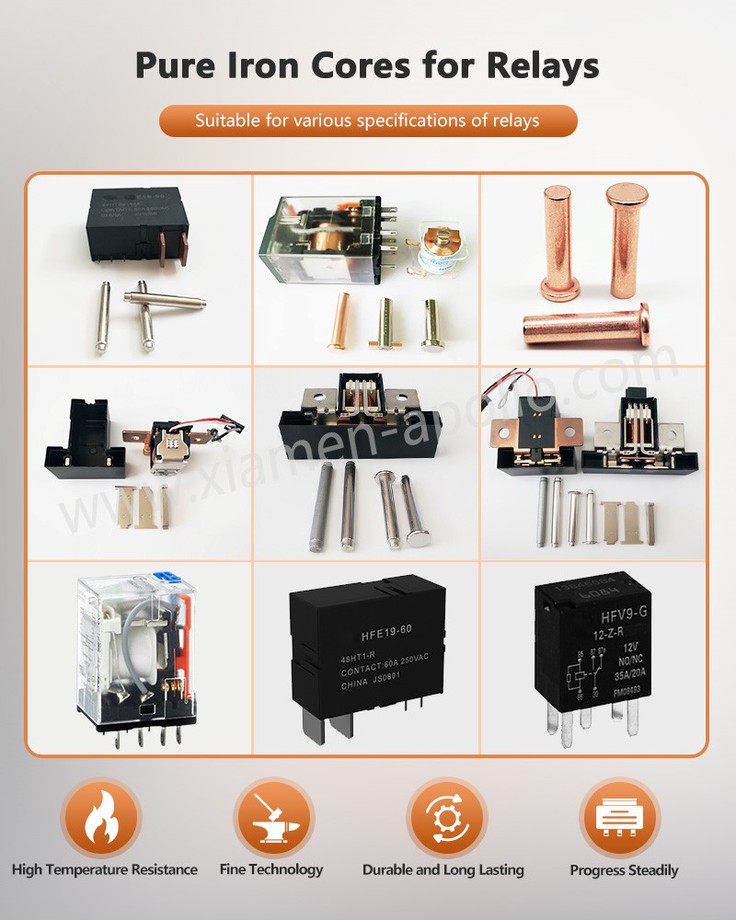
Furthermore, the pushrod and magnetic circuit structures within AC relays also significantly influence overall performance. High-precision AC rod assemblies enhance operational stability and minimize mechanical deviations, thereby ensuring the consistency and reliability of the relay throughout its long-term operation. Demand for such precision components is continuously rising across the fields of industrial automation, new energy control systems, and smart home appliances.
As a core constituent of the relay's magnetic circuit system, a high-quality iron core relay component is critical not only to the relay's pull-in efficiency but also directly impacts the product's service life, energy consumption, and operational noise levels. Consequently, the selection of stable and reliable materials-along with precision manufacturing processes-is of paramount importance in enhancing the overall performance of the relay.
If you are seeking high-quality relay cores or precision magnetic component solutions, we invite you to contact us for further product information and technical support; we are fully equipped to provide specialized customization services tailored to meet the specific requirements of diverse applications.
contact us
